Por onde anda? Milan Tide — The Resurrection (and the Registry Puzzle)
Also available in Portuguese
Por onde anda? Milan Tide – A Ressurreição (e o quebra-cabeça de registro)Read in Portuguese →Automatically generated translation; may contain errors.
By WSB Advisors
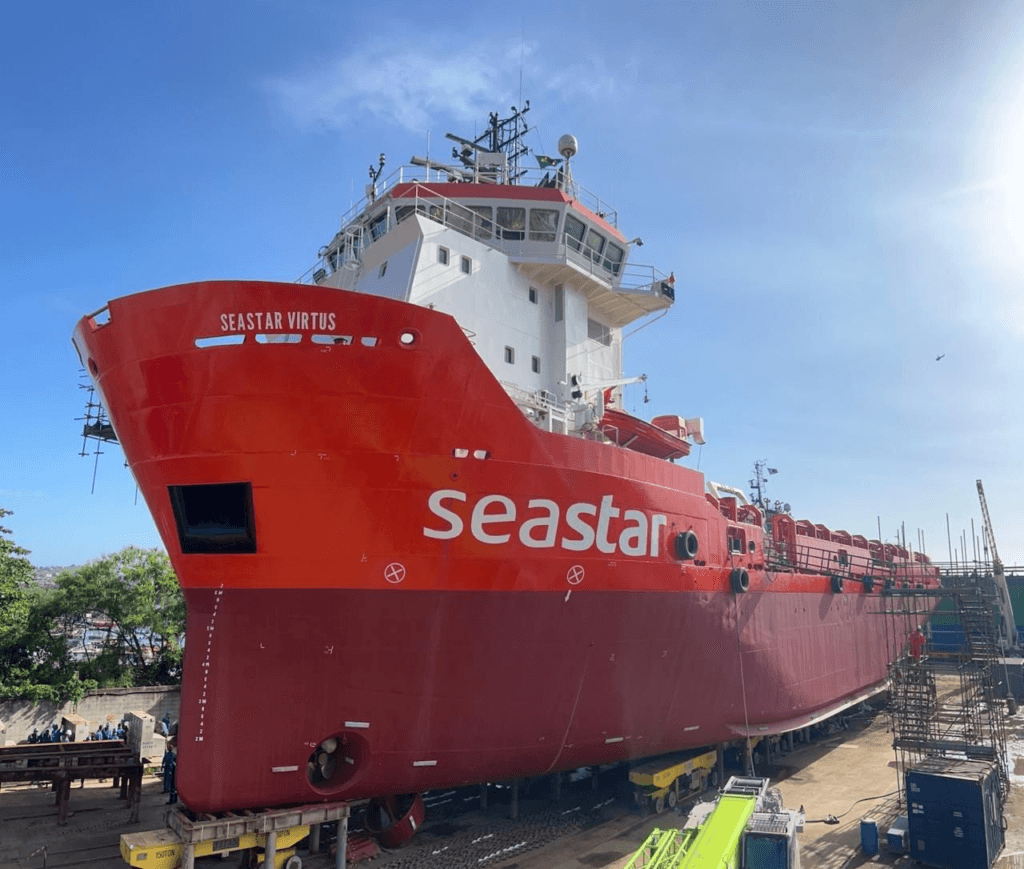
The return of Milan Tide, now Seastar Virtus, should have been a straightforward story: a well-built PSV, revived, reintroduced and ready to operate again. It turns out the story is not quite that simple.
Following our publication, Astromarítima Navegação S.A. – em Recuperação Judicial approached us demanding the rectification of a specific point: according to them, the vessel was not sold to Seastar, but rather placed under a bareboat charter agreement.
Here, the space is duly given, and the clarification made public.
However, context matters. The interpretation adopted in our original article was not speculative. It was grounded in publicly available signals, including Seastar’s own communication referring to Seastar Virtus as “our vessel, baptized Seastar Virtus”—language that, in any market, reasonably implies control consistent with ownership or quasi-ownership structures.
If the structure is indeed a bareboat charter, the natural question is: where is this reflected?
The answer, at least for now, is that it is not.
A verification with ANTAQ introduces a different layer to the story. The vessel—still referenced as CMT Matos and legally tied to Astromarítima Navegação S.A. – em Recuperação Judicial according to their statement—appears, in parallel, to be featured under a bareboat charter to Oceanica, forming part of its registered fleet and contributing to its tonnage and REB framework.
This raises a straightforward, but unavoidable question.
If Seastar has, for months, been the charterer of the same vessel under a bareboat charter agreement with Astromarítima Navegação S.A. – em Recuperação Judicial, how is it that the very same unit is also chartered—and formally registered—as part of Oceanica’s fleet?
Different names, same steel.
A vessel cannot, in practical and regulatory terms, be subject to two concurrent bareboat structures serving distinct operators, particularly when such arrangements underpin fleet composition and REB-linked tonnage rights.
We remain open to receiving any documentation that reconciles these elements, and will continue to examine this and similar cases, as the situation raises a broader question as to how such structures are being implemented in practice—and whether they are consistent with the applicable regulatory framework.
When approached, ANTAQ did not deny the underlying information, but opted not to take a definitive position, noting that a conclusive answer would require further analysis and consolidation of data.
This article was produced by Westhon Media for One Energy News.