
Petrobras Unveils its 2026–2030 Business Plan
Petrobras Unveils its 2026–2030 Business Plan, Signaling a New Growth Cycle with Direct Impacts on the Naval and Offshore Industry
Petrobras presented its official 2026–2030 Business Plan last Friday, December 5, at the Firjan headquarters in Rio de Janeiro. The event brought together company executives, industry representatives, institutional leaders and numerous guests from across the energy sector. The presentation, delivered by technical specialists and managers from multiple business units, outlined not only the company’s strategic direction for the next five years but also a clear view of the role that oil, natural gas and low-carbon fuels will play in Brazil’s energy matrix through 2050.
The plan reinforces Petrobras’ ambition to maintain a leading position in the nation’s energy supply, combining growth in oil and gas output with increasing investments in biofuels, petrochemicals and low-carbon energy solutions. The company also reiterated its firm commitment to a “just” energy transition, aligned with national energy security and the competitiveness of Brazil’s industrial base.
A plan launched in a challenging market environment
The presentation began with a pragmatic assessment: market conditions in 2025 proved more challenging than anticipated, with Brent prices falling below the assumptions adopted in the previous plan. Even so, the new plan is anchored in operational discipline and capital efficiency, projecting a breakeven Brent of US$ 59/bbl as early as 2026.
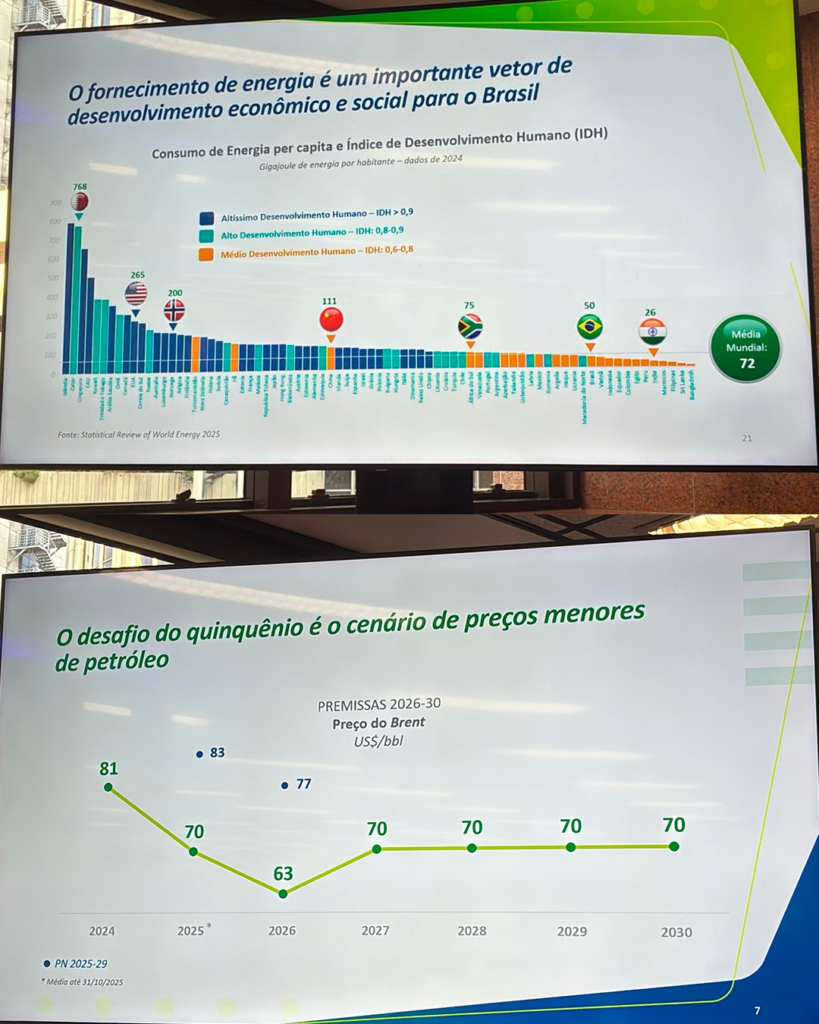
Despite this scenario, Petrobras reaffirmed ambitious targets for production growth, supported by structural improvements in efficiency, governance and cost optimization.
Oil and gas production accelerates and underpins new investments
Petrobras expects to deliver consistent growth in oil and natural gas production throughout the five-year period. The updated forecast points to approximately 2.4 million barrels per day in 2025, stabilizing between 2.6 and 2.7 million barrels per day by 2030.
This expansion is driven by a robust portfolio of pre-salt and post-salt projects, including new FPSOs, upgrades to existing systems and around 100 additional development wells by 2030. Among the highlights are the Búzios 6 through 11 projects, Atapu 2, Sépia 2, Raia and the Mero Extension, which form the core of pre-salt production growth.

Natural gas output is also set to expand, with domestic availability projected to reach 67 million m³/day by 2030.
US$ 109 billion in investments and a portfolio built for resilience
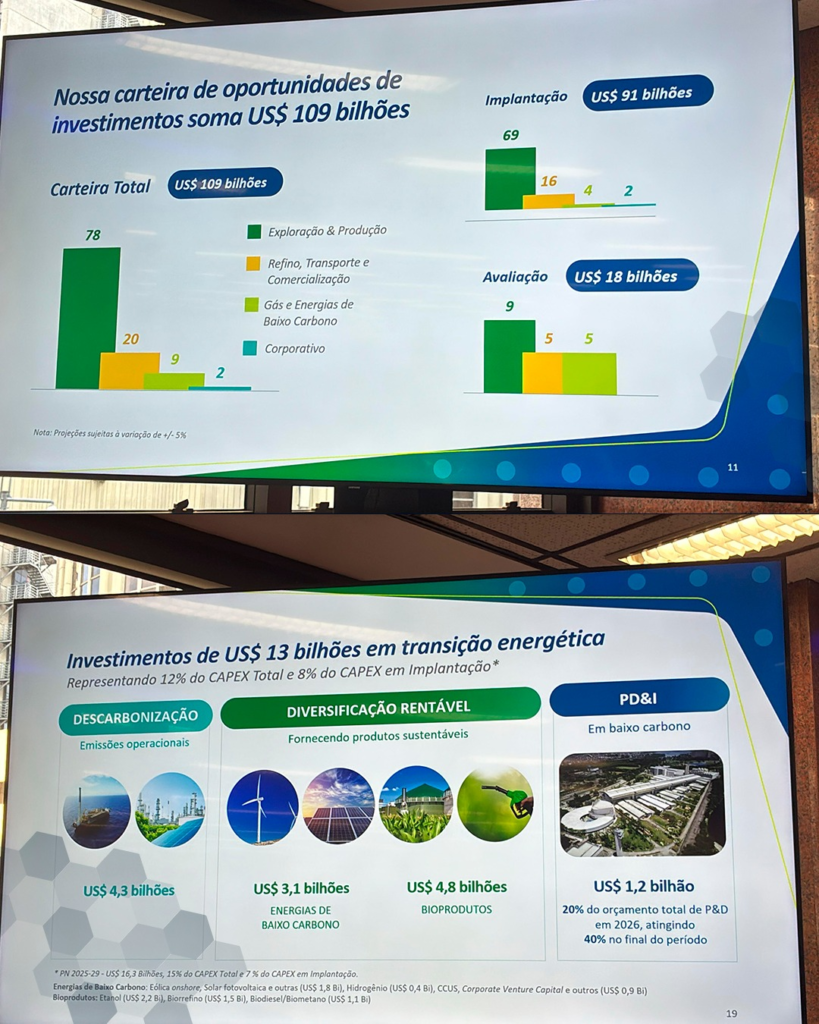
Combined, the investments outlined in the plan reach US$ 109 billion. The largest share — US$ 91 billion — is already in the implementation phase. The capital is allocated primarily across:
- Exploration & Production;
- Refining, Transportation and Marketing;
- Gas and Low-Carbon Energy;
- Corporate Projects.
The company emphasized that, even under lower oil-price assumptions, it will maintain a gross debt ceiling of US$ 75 billion, converging to US$ 65 billion by the end of the decade, ensuring its dividend policy and long-term self-funding capacity.
Maritime logistics, fleet renewal and direct impact on the naval sector
One of the most anticipated segments of the presentation involved the Mar Aberto program, a comprehensive initiative to overhaul Petrobras’ maritime logistics and modernize its fleet. The plan allocates approximately US$ 2 billion to new vessels, which may translate into nearly US$ 4 billion in domestic shipbuilding activity.
The package includes:
- 20 coastal navigation vessels;
- 18 barges and pushers for bunker operations;
- 12 PSVs;
- 10 OSRVs;
- 16 RSVs;
- 2 AHTSs.
This initiative — one of the most significant naval-sector announcements made by Petrobras since the early 2010s — has the potential to reactivate shipyards, revive suppliers and restore operational capacity across a supply chain that has remained largely underutilized for nearly a decade.
The company also confirmed the continuation of its offshore vessel chartering program, noting that roughly 40 new offshore support vessels will be contracted to sustain E&P activities throughout the period.
For a sector that has endured almost ten years of subdued activity, the message was explicit: the pace of exploration and production planned for the coming years will require renewed and expanded capacity within Brazil.
Expansion of refining capacity and new industrial projects
Petrobras also outlined its portfolio of structural investments in refining, logistics and natural gas. Key highlights include:
- new biorefining projects at REPLAN, RPBC and Boaventura;
- expansion of HDT and HDS units;
- increased export and propylene handling capacity;
- new pipeline infrastructure in Brazil’s Center-West region;
- modernization and construction of vessels for refined-product transportation.
Together, these initiatives reinforce the company’s objective of increasing domestic processing of Brazilian crude, reducing import dependence and boosting the supply of higher-quality fuels.
Energy transition: focus on biofuels and low-carbon solutions
Petrobras has earmarked US$ 13 billion for low-carbon and bioproduct initiatives — the largest investment ever allocated to this area in the company’s history.
The funds target:
- ethanol, biodiesel and biomethane;
- renewable diesel (R5);
- SAF and biobunker;
- hydrogen projects;
- carbon capture, utilization and storage;
- onshore solar and wind;
- innovation and R&D in clean energy technologies.
The company emphasized that, while Brazil’s energy mix remains significantly more renewable than the global average, fossil fuels will continue to play a relevant role in the decades ahead. The strategy, therefore, is to expand oil and gas production while laying the foundation for a diversified portfolio of sustainable, higher-value energy products.
Employment, economic impact and social value
As a final highlight, Petrobras estimated that the investments under the plan could support 311,000 direct and indirect jobs across the country.
Projected tax contributions — spanning federal, state and municipal jurisdictions — total R$ 1.4 trillion, underscoring the company’s role not only as an energy producer but as a critical driver of economic and social development.
This article was produced by Westhon Media for One Energy News.