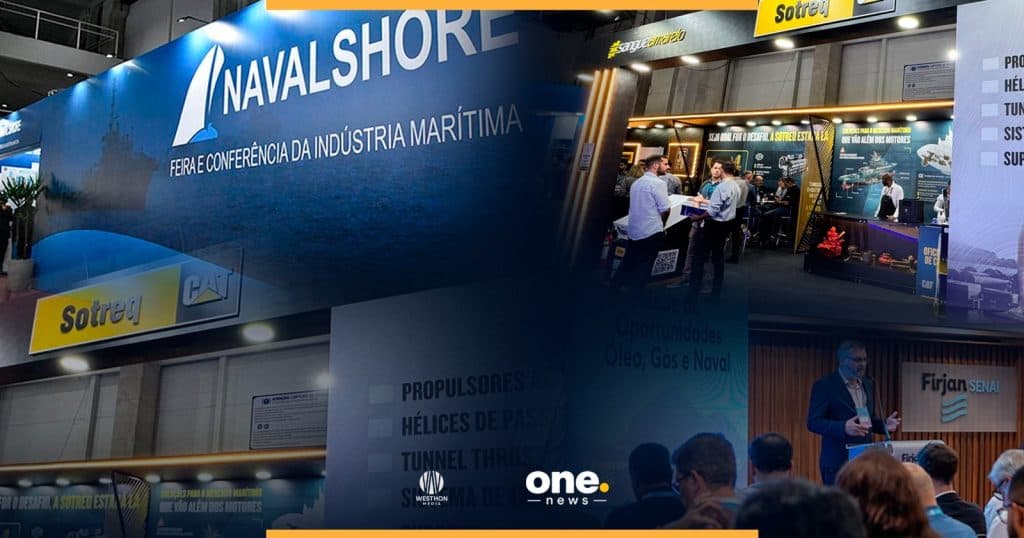
Navalshore 2026 opens with new vessel investments and focus on execution
Also available in Portuguese
Navalshore 2026 abre com novos investimentos de navios e foco na execuçãoRead in Portuguese →Automatically generated translation; may contain errors.
Transpetro’s R$630 million inland navigation program, new estimates for Brazil’s shipbuilding pipeline and initiatives focused on financing, suppliers and technology are setting the tone for Navalshore 2026 in Rio de Janeiro.
Navalshore 2026 opened on August 18 in Rio de Janeiro as Brazil’s maritime industry enters a new phase of investment.
The 20th edition brings together around 180 exhibitors and more than 650 Brazilian and international brands, with approximately 20,000 visitors expected over the three-day event.
The main discussion this year, however, is not whether Brazilian shipbuilding is recovering. New orders are already entering the market. Attention is shifting to financing, supplier capacity, technology and the ability of Brazilian shipyards to execute a growing pipeline of projects.
Transpetro adds 36 vessels to its pipeline
One of the main announcements from the opening day came from Transpetro.
The Petrobras logistics subsidiary detailed an investment of approximately R$630 million in 18 barges and 18 pushboats as part of its entry into inland navigation.
The vessels are being built in Brazil and will initially support bunker transportation in Rio de Janeiro, with plans to later expand the operation to Santos and Belém.
The program adds another vessel segment to the current Brazilian newbuilding cycle, which already includes tankers, offshore support vessels and other fleet renewal projects.
Transpetro also used Navalshore to discuss its broader fleet expansion strategy and the adoption of more efficient, automated and lower-emission vessels.
Firjan estimates R$32 billion in vessel demand
Firjan released the seventh edition of its Panorama Naval no Rio de Janeiro during the event.
According to the study, Petrobras’ Mar Aberto program could generate demand for *96 new vessels through 2032, representing approximately *R$32 billion in investment.
The pipeline includes 40 offshore support vessels, 20 cabotage ships, 18 barges and 18 pushboats.
The study also highlights the size of Rio de Janeiro’s existing industrial base. The state concentrates 24 of Brazil’s 49 shipyards and 66,000 of the country’s 181,000 jobs related to naval activities.
This capacity will be important not only for new construction, but also for maintenance, repair, modernization and decommissioning of Brazil’s existing offshore fleet.
Suppliers move closer to buyers
Supplier development is another central issue at this year’s Navalshore.
Firjan SENAI and Sebrae are bringing potential suppliers into direct contact with procurement teams from Transpetro, the Brazilian Navy, Mauá Shipyard and Hanwha Ocean.
The initiative addresses a practical challenge facing the current expansion cycle. New vessel orders create opportunities for local industry only if suppliers can meet technical requirements, delivery schedules and commercial conditions.
ABEEMAR and ApexBrasil also launched Invest in Brasil – Shipbuilding & Offshore, a program designed to attract foreign investment, equipment manufacturers and technology companies to Brazil’s naval and offshore markets.
International interest is already visible at the event. Chinese participation increased from four exhibitors in 2025 to 19 this year, reflecting stronger interest in Brazil’s maritime investment cycle.
Financing remains a key issue
The Merchant Marine Fund, FMM, is again becoming central to Brazilian shipbuilding.
During Navalshore, the federal government disclosed that it is evaluating measures to reduce interest rates on FMM financing denominated in reais.
The discussion is relevant because shipyard capacity depends on more than physical infrastructure.
Owners and builders need competitive financing, guarantees and working capital throughout construction. As orderbooks increase, the cost and availability of capital will directly affect the industry’s ability to deliver projects.
Technology enters the next newbuilding cycle
Technology suppliers are also using Navalshore to present solutions for the next generation of Brazilian vessels.
Propulsion efficiency, electrification, automation, batteries, monitoring systems and predictive maintenance are among the main technologies being discussed across the exhibition.
Sotreq is presenting marine propulsion systems, batteries, remanufactured components and monitoring solutions, while other suppliers are focusing on electric motors, automation and lifecycle efficiency.
These technologies are becoming increasingly relevant as shipowners evaluate not only acquisition cost and installed power, but also fuel consumption, emissions, maintenance requirements and operating performance over the life of a vessel.
What comes next at Navalshore
The second day of the event moves further into the industrial structure behind Brazil’s current shipbuilding cycle.
The agenda includes discussions on Renaval, tax reform and the integration of Brazilian marine equipment manufacturers into new vessel programs.
Supplier meetings with Transpetro, the Brazilian Navy, Mauá Shipyard and Hanwha Ocean are also moving into direct discussions with participating companies.
ABB Marine & Ports and Transpetro will address the next generation of shuttle tankers, including electrification, automation and digital technologies for future offshore operations.
The final day will bring decommissioning and maritime decarbonization into focus, two markets that could generate additional demand for Brazilian engineering companies, service providers and shipyards beyond conventional vessel construction.
The issue now is execution
Navalshore 2026 is taking place at a moment when vessel demand in Brazil is no longer theoretical.
New orders are being placed, shipyards are receiving work and operators are preparing larger fleets.
The questions are now more specific: whether financing will remain competitive, whether suppliers can scale up, whether new technologies can be incorporated efficiently and whether Brazilian yards can deliver several programs on schedule.
Brazil has the demand.
The next test is execution.
This article was produced by Westhon Media for One Energy News.