MDL completes deepwater SURF recovery in Shell’s Bijupirá-Salema decommissioning
Maritime Developments Limited (MDL) has completed a deepwater SURF recovery campaign in the Campos Basin as part of the decommissioning of Shell Brasil’s Bijupirá and Salema fields.
MDL did not identify the field operator or its customer when announcing the project. However, public disclosures from companies and personnel involved in the work identify the campaign as Bijupirá-Salema. One contractual distinction remains important: MDL states that the vessel owner engaged the company to develop the recovery solution, and available public information does not establish that MDL was contracted directly by Shell.
The offshore scope was executed from the Island Enforcer, an offshore support vessel operated in Brazil by Bram Offshore. The campaign covered 21 subsea products, ranging from 2.5-inch gas-lift risers to 9.5-inch gas-export flowlines, in water depths of approximately 770 meters.
The technical approach is one of the most relevant aspects of the project. Rather than sourcing a dedicated decommissioning vessel such as a PLSV, the field operator evaluated whether an OSV already under charter could be adapted for the recovery scope.
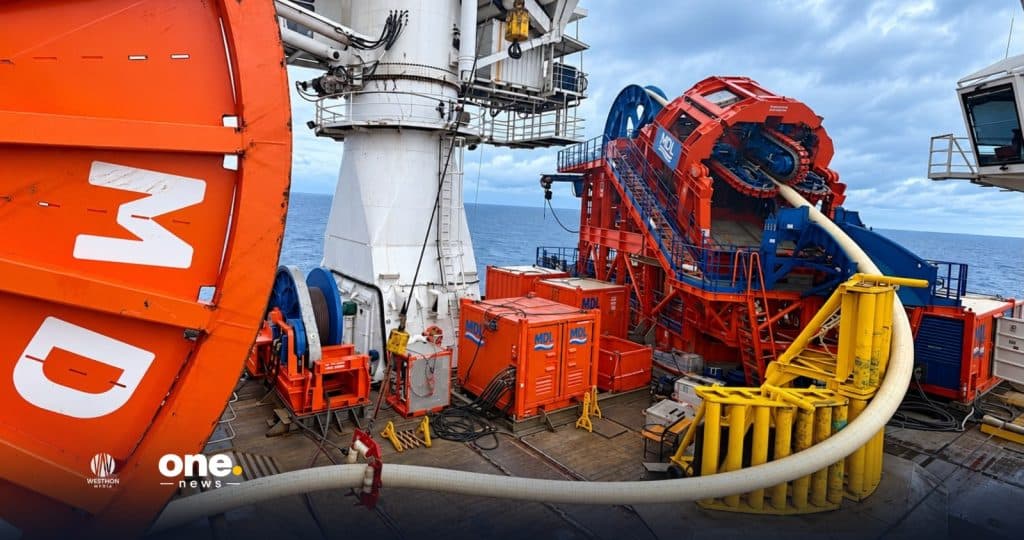
MDL first performed a FEED study to define the recovery methodology and back-deck configuration before supplying a modular spread that included its Wheeled Horizontal Lay System, Generation 3 Reel Drive System, installation reels, winching equipment and a 110-tonne tensioner.
According to MDL, the configuration allowed recovery loads of up to 105 tonnes and the campaign was completed 19 days ahead of the client’s forecast. The company specifically attributes part of the result to the wheeled overboarding arrangement, which reduced the capstan effect during retrieval.
The offshore execution followed almost two years of engineering work. NSG Engenharia says the first FEED activities for the Bijupirá-Salema campaign began in July 2024, followed by feasibility studies, hydrodynamic and operability analyses, weather-window assessments, rigging and seafastening engineering, logistics studies and recovery procedures.
A professional directly involved in the offshore execution later reported an approximately 80-day campaign aboard Island Enforcer, during which around 35 km of flexible flowlines were recovered. The same disclosure identifies Shell, Bram, C-Innovation, MDL, Mecus, BravOcean and NSG among the companies involved in the work.
The SURF recovery is one part of a much larger decommissioning program. Shell operates Bijupirá and Salema with an 80% interest, alongside Petrobras with 20%. Production ended in 2021 after almost two decades under Shell operation, during which the fields produced the equivalent of more than 140 million barrels of oil. Shell’s overall decommissioning program also includes permanent abandonment of 22 wells and removal of subsea pipelines and equipment.
Earlier phases involved other contractors. In 2023, Subsea7 received a Shell contract covering the disconnection, recovery and disposal of 10 flexible risers, three umbilicals and nine mooring lines associated with the FPSO Fluminense. DOME subsequently signed a contract directly with Shell to act as the onshore base for the second phase of the Bijupirá-Salema decommissioning, with activities beginning in January 2026.
Beyond the individual campaign, the project provides a practical example of how existing offshore support tonnage can be reconfigured for complex deepwater decommissioning scopes. In this case, the combination of engineering, modular recovery equipment and an OSV already under charter avoided the need to source a dedicated PLSV for the work.
This article was produced by Westhon Media for One Energy News.