Buying High, Selling Low? Not Quite – The Hidden Economics of Petrobras and PETRONAS
There is a certain seduction in simple narratives.
Petrobras sold a 50% stake in Tartaruga Verde and the Module III of Espadarte to PETRONAS in 2019 for roughly US$1.2 billion. Six years later, it is buying that same stake back for approximately US$450 million. The conclusion, widely circulated in market commentary, appears self-evident: Petrobras sold high, PETRONAS bought high — and then sold low.
It is a compelling story. It is also, on closer inspection, fundamentally misleading.
What appears to be a case of value destruction is, in reality, a case of value extraction — and a useful lens through which to understand how capital has actually been deployed in Brazil’s upstream sector.
The first source of confusion lies in the numbers themselves. The US$1.2 billion headline in 2019 incorporated economic adjustments, including cash flows generated between the effective date and closing, implying a lower underlying asset valuation. The repurchase price today is likewise subject to interim performance adjustments. Even after normalising for these effects, however, PETRONAS is exiting at a lower nominal price than it entered.
But upstream economics are not determined at entry or exit alone. They are determined in the years in between — in the conversion of reserves into cash.
When PETRONAS acquired its stake, Tartaruga Verde was at a particularly attractive point in its lifecycle. Capital expenditure had largely been deployed, production was near peak, and the asset was transitioning into a cash-generative phase. For a non-operating partner, this is precisely where value tends to concentrate.
Over the following years, that positioning proved advantageous. Production remained resilient in the early period, oil prices recovered sharply post-pandemic, and the asset delivered exposure to offshore barrels without incremental capital burden. In effect, PETRONAS did not simply acquire reserves in the ground, but barrels already in motion — and monetised them at favourable points in the cycle.
By the time of exit, the picture had shifted. Production had declined, the asset had matured, and the remaining reserves offered a less intense near-term cash profile. To focus on the exit price without accounting for the cash extracted along the way is to miss the central economic logic of the transaction.
Our analysis suggests that PETRONAS likely recovered its initial investment through cumulative cash flows over the holding period. The exit price, therefore, should be seen not as the return itself, but as what remained after the return had already been realised. This is closer in nature to a private equity-style strategy: enter post-development, harvest cash during a favourable cycle, and exit before the steeper phase of decline. Such strategies are not designed to maximise terminal value, but to optimise internal rate of return — and on that measure, the transaction stands out.
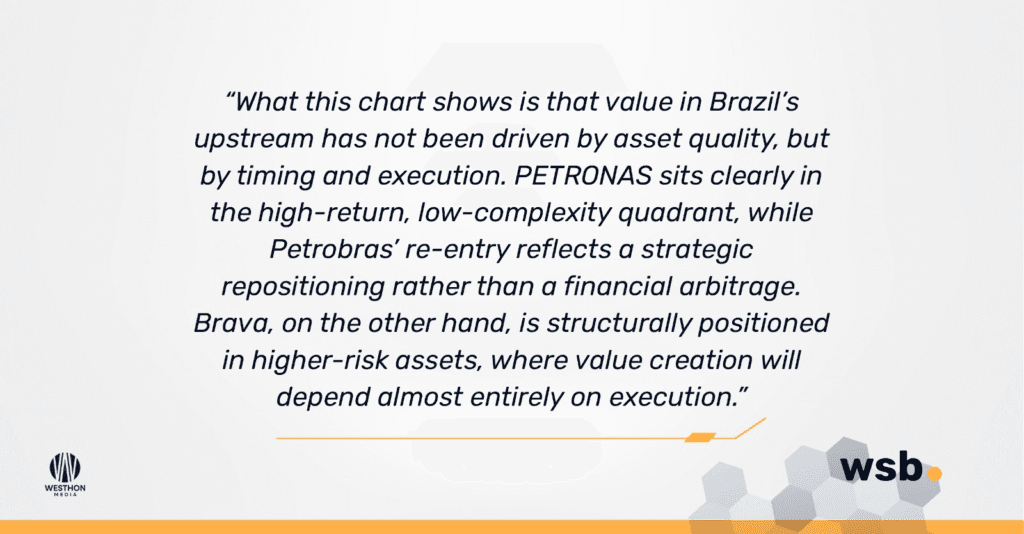
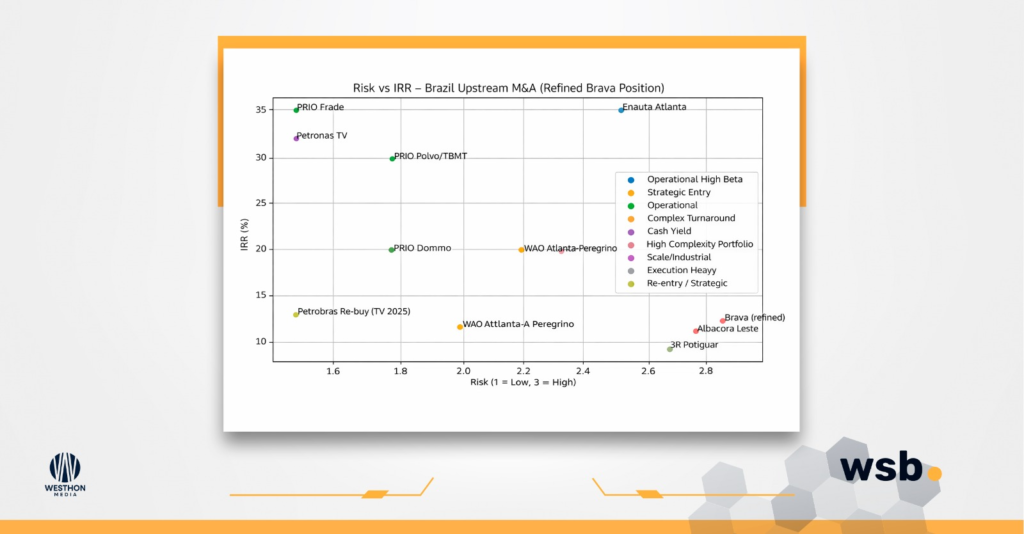
Placing this deal within the broader Brazilian M&A landscape reinforces the point. Mapping transactions across execution risk and expected returns reveals a wide dispersion of outcomes. A small subset of deals — typically driven by timing or targeted operational intervention — cluster in the high-return, controlled-risk quadrant. PETRONAS’ investment in Tartaruga Verde fits squarely within this group. Others, driven by scale or consolidation, tend to deliver more institutional returns, while more complex portfolios — often involving operational integration or technical challenges — carry higher risk without necessarily offering proportionate upside.
Within this framework, Petrobras’ re-entry sits in a different category altogether. The implied returns are more moderate, but the rationale is not primarily financial arbitrage. Rather, it reflects a strategic decision to consolidate control over a producing asset in which the company is already operator, simplifying governance and potentially unlocking operational synergies across its portfolio.
This distinction is essential. PETRONAS approached the asset as an investor, optimising for cash yield and timing. Petrobras is approaching it as an operator and long-term holder, optimising for control and integration. The same barrels can support different valuations depending on the strategy applied to them.
More broadly, the transaction exemplifies a recurring feature of the Brazilian upstream market: asset quality alone does not determine outcomes. Several of the most successful deals in recent years have involved mature or technically complex fields. What differentiates performance is not geology, but execution — and, in some cases, simply timing. The same asset, under different operators or strategies, can produce materially different returns.
Viewed in this light, the Petrobras–PETRONAS sequence is less a contradiction than a transition. In 2019, Petrobras divested a non-core stake to optimise its balance sheet, while PETRONAS entered to capture yield. In 2025, those roles have effectively reversed: PETRONAS exits after harvesting value, and Petrobras re-enters to reinforce its core portfolio. Both decisions are internally consistent. The perceived asymmetry arises only when they are judged through the same lens.
Read also: Tartaruga Verde: Petrobras, Brava and Petronas
The broader lesson is straightforward, if often overlooked. In upstream oil and gas, value is rarely created at a single point in time. It is created along the production curve — through timing, execution, and strategic alignment.
For those focused solely on headline prices, the Petrobras–PETRONAS deal may appear puzzling. For those looking at the full economic cycle, it is something else entirely:
A well-executed trade on one side, and a strategic repositioning on the other.
What else?

“Coming soon…
I’ve seen a number of takes suggesting that PETRONAS “lost money” on this deal — buying high and selling low.
The reality is quite the opposite.
When you properly unpack the cash flows, timing, and production profile, this turns out to be one of the most efficient upstream trades executed in Brazil in recent years.
Following this divestment, PETRONAS would rank 1 in my Brazil oil and gas deal league table — not despite the exit price, but because of it.
As for Petrobras, the narrative is more nuanced.
Selling at ~US$1.2 billion and re-entering at a fraction of that does not, in itself, define value creation or destruction. The economics sit beneath the headline numbers — and the strategic rationale is far more complex than the surface suggests.
More to come.”, reflects Alexandre Vilela, CEO of WSB Advisors.
This article was produced by Westhon Media for One Energy News.