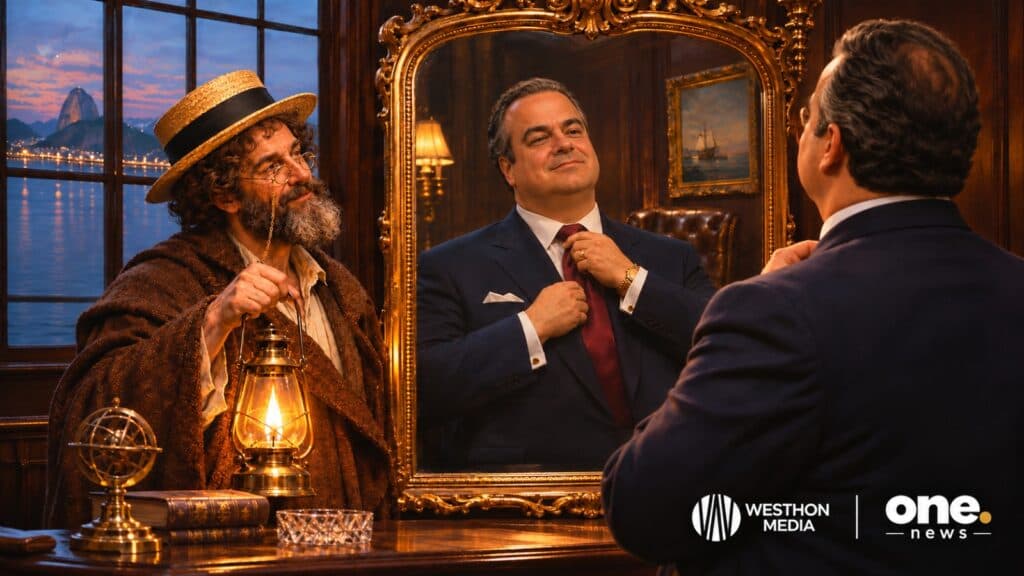
Diógenes, the Cynic
The Man Who Made It on His Own
Automatically generated translation; may contain errors.
By Diogenes the Cynic
The story goes that I once begged alms from a statue. When asked why, I said I was getting used to being turned down.
A simple exercise. The statue gave nothing, but promised nothing either. It never called me a partner.
I thought of it the other day in Rio de Janeiro, listening to a man explain how he had established himself in a new market.
He had done it all on his own.
Remarkable, I thought. Especially as I remembered quite a few people carrying his luggage.
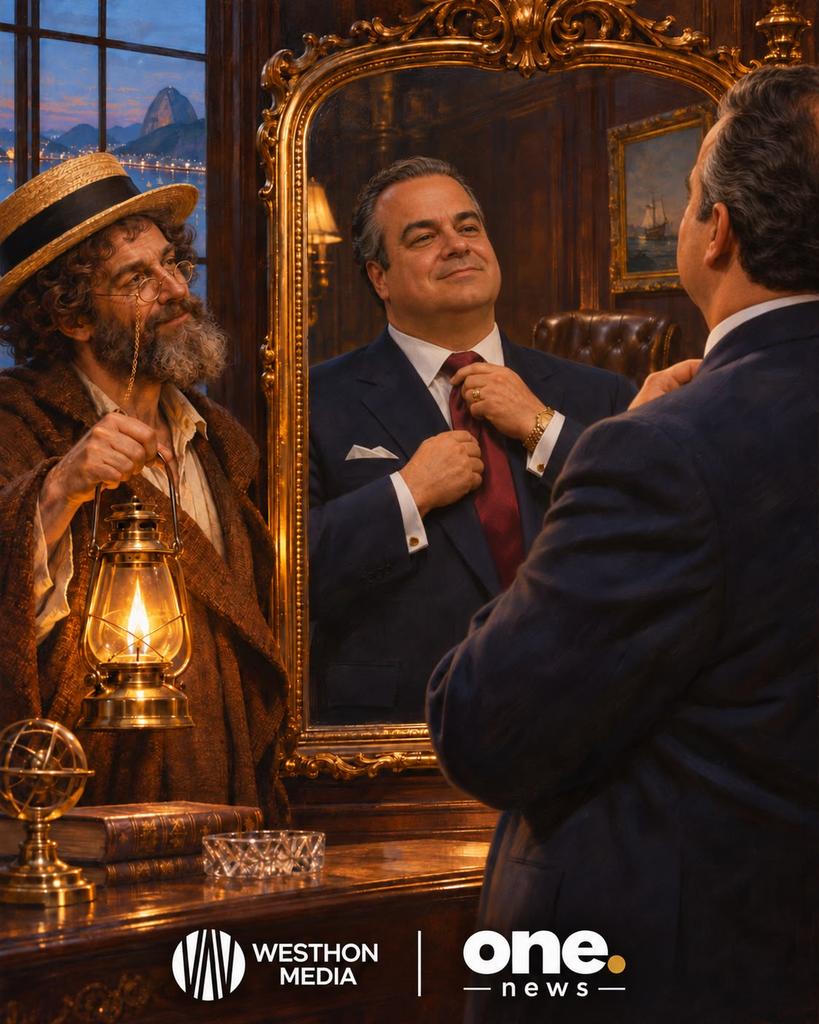
For this little comedy, I turn to Machado de Assis and borrow Jacobina from The Mirror: the man who finds his sense of self in an officer’s uniform. Mine had exchanged the uniform for a job title. Instead of epaulettes, he wore the name of a major corporation beneath his signature.
It suited him. So well that he could no longer tell where the company ended and the man began.
When he first arrived, he knew little about the market. He needed introductions, references, someone to explain the difficulties before they became expensive. He needed people who trusted a familiar face to give an unfamiliar one a hearing.
He found someone willing to open those doors.
The first meeting happened because someone introduced him. The second, because someone persisted. There were explanations, adjustments and misunderstandings to resolve. Someone put their own reputation on the line while the company was still building one locally.
That part tends to disappear from success stories.
Jacobina was very grateful.
He spoke of “our project”, “our achievement”, “our partnership”.
The plural was enjoying an excellent run.
Then came the contracts. Names became familiar, calls were answered directly, and introductions were no longer required.
Jacobina began to feel that his old partner stood between him and the client.
Before, the partner had stood between him and a closed door. But that memory seemed to complicate the new organisational chart.
“We have a direct relationship now,” he explained.
I asked how they had acquired it.
He answered with last quarter’s results.
Not quite what I had asked, but I gathered the figures had been brought in to close the discussion.
I raised my lamp.
In the presentation, the achievement was attributed to Jacobina’s vision. There were photographs, charts and a generous account of his ability to develop business.
I looked for the others.
Perhaps they were on the next slide.
They were not.
Vanity rarely needs to invent an entire story. It need only remove the people who make its central character less extraordinary.
I do not doubt that Jacobina had worked hard. What struck me was how easily he turned his contribution into sole credit.
Those who had negotiated, taken risks or held a difficult conversation together gradually disappeared as he perfected his account of the success.
What remained was a highly capable man addressing an audience that had never attended the rehearsals.
I asked about his old partner.
He said it was time to look ahead.
A curious notion of progress, I thought, if it required losing one’s memory.
I do not believe a business relationship must last forever. Work comes to an end, organisations change, paths diverge. Gratitude does not oblige anyone to keep hiring the same people indefinitely.
But there is a difference between bringing a relationship to a close and rewriting its beginnings because the commitments made along the way have become inconvenient.
The real test of loyalty begins when you no longer need the other person.
While we need an introduction, we are attentive. While we are waiting for an answer, we remember names, ask after families, find the time.
Only once the door is open do we discover whether it was respect or merely urgency.
Jacobina did not much care for that observation.
He explained that his loyalty was to the company.
A convenient arrangement, it seemed to me: in its name, he could forget his commitments to others while claiming personal credit for the results he delivered.
I asked whether the company would be equally loyal when it no longer needed him.
He said his situation was different.
It usually is, when it is ours.
That was when I remembered the uniform.
People take calls because of a title, make concessions because of a company, clear their diaries because of a budget. The person in the chair can spend years mistaking that attention for something uniquely his own.
Until the nameplate on the door is changed.
All it takes is a reorganisation, new management, an email thanking him for his contribution and wishing him well in his future endeavours.
The phone is still in the same man’s hands. It no longer rings quite so often.
Perhaps then he will look up the people he used to speak to before he became self-sufficient.
I do not know who will answer. This comedy has not reached that part yet.
That afternoon, Jacobina walked me out. In the lift, he adjusted his tie in the mirror and checked a message on his phone.
I had one last question.
Once they took away his title, who would still ask for him by name?
This article was produced by Westhon Media for One Energy News.