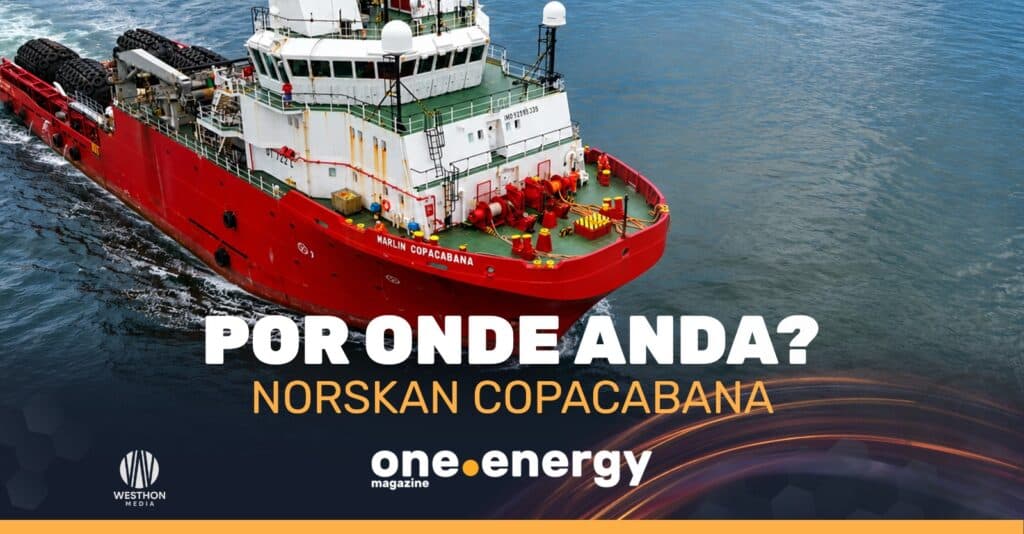
Por onde anda? Norksan Copacabana
Automatically generated translation; may contain errors.
The name Skandi Copacabana became associated with an important phase of offshore support navigation in Brazil.
Before operating under that name, the vessel was registered as Norskan Copacabana. Built in 2005 at Estaleiro Ilha, in Rio de Janeiro, she emerged during a period of expansion in the Brazilian offshore market, when demand for support vessels was growing alongside the development of exploration and production activities in the country.
The vessel was designed as an AHTS, a category focused on anchor handling, towing and supply operations. In practical terms, this type of asset is used to tow offshore units, deploy and recover anchoring systems, and provide logistical support to offshore operations.
With approximately 80.5 meters in length, around 18 meters of beam and a deadweight close to 2,400 tonnes, the vessel was part of a generation of offshore support vessels built to serve a market that demanded more power, deck capacity and operational resources. The UT 722L design, the reported bollard pull of approximately 206 tonnes and the anchor handling systems reinforced this profile.
But the relevance of the Skandi Copacabana is not limited to her technical characteristics. She also helps tell part of the evolution of the Brazilian offshore support market.
In the 2000s, Brazil was experiencing a cycle of offshore expansion. Vessel construction in the country, the presence of international groups and the growing demand for offshore support created space for a more robust and specialized fleet. The then Norskan Copacabana was born within that environment.
Later, already as Skandi Copacabana, the vessel carried the operational identity linked to Norskan/DOF in Brazil, at a time when the group maintained a relevant presence in offshore support navigation.
The most relevant change came from 2015.
At that time, funds managed by Mantiq Investimentos and Mare Investimentos acquired five offshore support vessels from Norskan Offshore in Brazil. Among them were the PSVs Skandi Stolmen and Skandi Yare, the OSRV Skandi Leblon, the PSV Skandi Flamengo and the AHTS Skandi Copacabana.
In 2016, Marlin Navegação was authorized by ANTAQ to operate as a Brazilian shipping company in offshore support navigation. From that restructuring, the Skandi Copacabana became part of a new corporate and operational configuration within the Brazilian market.
That movement helps explain a change of phase in the sector. Part of the fleet built or incorporated during the expansion cycle began to be repositioned in a more selective market, pressured by fleet adjustments, contract renegotiations, shifts in demand and greater operational discipline among shipowners.
Today, the former Skandi Copacabana appears in public records as Marlin Copacabana, IMO 9283435, under the Brazilian flag. The vessel remains associated with Marlin Navegação and appears in recent publications as part of the fleet operated by Grupo Bravante.
The asset retains its original AHTS profile. In other words, it continues to be identified as an offshore support vessel focused on towing, anchor handling and logistical support. Public AIS records indicate recent presence along the Brazilian coast, but this alone does not confirm a specific contract, client or operational scope.
In the case of the Marlin Copacabana, the interest lies precisely in the reading that the vessel allows us to make of the market. Her trajectory crosses different phases of the Brazilian offshore sector: local construction, operation under the Skandi brand, sale to a new corporate structure, integration into Marlin and later operational association with Bravante.
That is why we chose to talk about her. Not only to locate a vessel that changed names, but to observe, through her, how the Brazilian offshore support market has also changed.
This article was produced by Westhon Media for One Energy News.