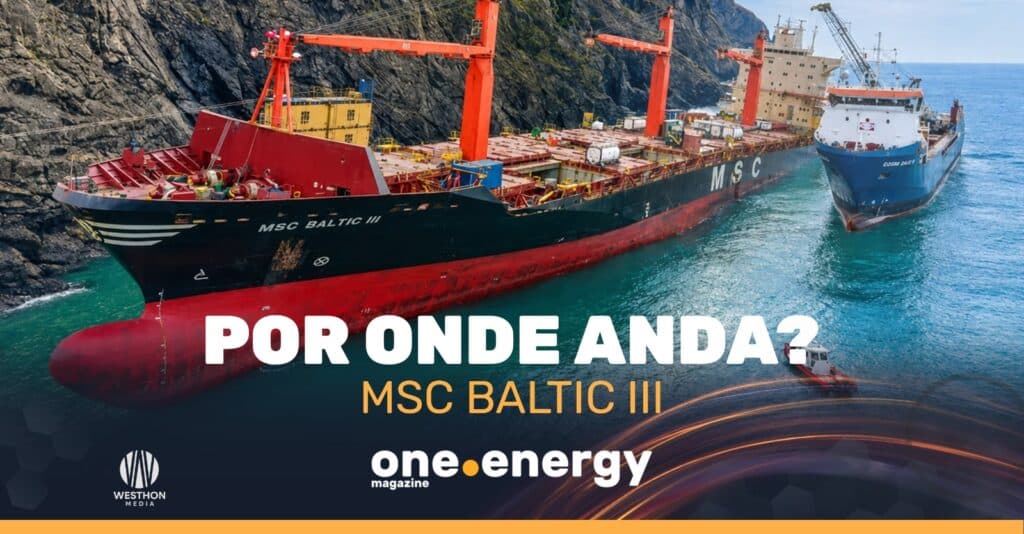
Por onde anda? MSC Baltic III
Automatically generated translation; may contain errors.
Por Onde Anda? – MSC Baltic III
The date was February 2025.
The MSC Baltic III was sailing off the west coast of Newfoundland, Canada, when it reported a loss of power near the entrance to Bay of Islands. Sea and weather conditions were adverse. Unable to secure an anchor, the containership eventually ran aground in the Wild Cove/Cedar Cove area, near Lark Harbour.
There were 20 crew members on board. All were safely airlifted from the vessel.
From that moment, the MSC Baltic III was no longer just another containership in commercial operation. It became one of the most closely monitored maritime cases in Canada.
More than a year later, the vessel is no longer being treated as a simple refloating case. The operation has moved into the wreck removal phase, with deconstruction work being carried out on site, land access being developed, and materials gradually removed from the vessel.
The initial response focused on crew safety, environmental protection, hull assessment, fuel removal and cargo removal. From the early inspections, the situation already pointed to a sensitive operation. There were reports of water ingress in some compartments, signs of structural deformation and a significant portion of the hull resting on the seabed.
As the months passed, the vessel’s condition became the main technical factor in the operation. Updates from the Canadian Coast Guard indicated hull damage, cracks, deformation, access limitations and repeated restrictions caused by sea state, wind, ice and severe weather.
By late February 2025, the Canadian authority indicated that, given the vessel’s condition at that stage, it could not be safely refloated. From then on, the discussion was no longer only about pulling power, buoyancy and emergency response. The case began to involve structural integrity, environmental risk, access logistics and the real feasibility of safe removal.
In 2026, the operation entered a new phase. Resolve Marine was retained as the contractor for the wreck removal stage. By June, the work had already progressed into the deconstruction phase, with increased operational presence on site, improvements to land access to Cedar Cove, construction of an access road down to the beach area and removal of materials from the vessel.
Built in 2003, the MSC Baltic III is a containership of significant size for this type of coastal operation. The vessel is approximately 207 meters long, about 30 meters wide and has a capacity close to 2,500 TEU. These figures help put the challenge into perspective: this is not a small vessel, but a large commercial ship grounded in an exposed area with limited operational access.
This is where the Canadian case becomes relevant to the maritime and offshore markets.
Without drawing a direct comparison, the MSC Baltic III offers a useful reference for situations such as the Skandi Amazonas in Brazil. In grounding cases, time is a technical factor. The longer a hull remains exposed, the greater the influence of sea conditions, weather, structural condition, access, environmental risk and removal feasibility.
Refloating, in these cases, does not depend only on pulling power. It depends on hull integrity, watertight condition, pollution control, weather windows, available logistics and the ability to move the vessel without turning the operation into a greater risk.
This article was produced by Westhon Media for One Energy News.