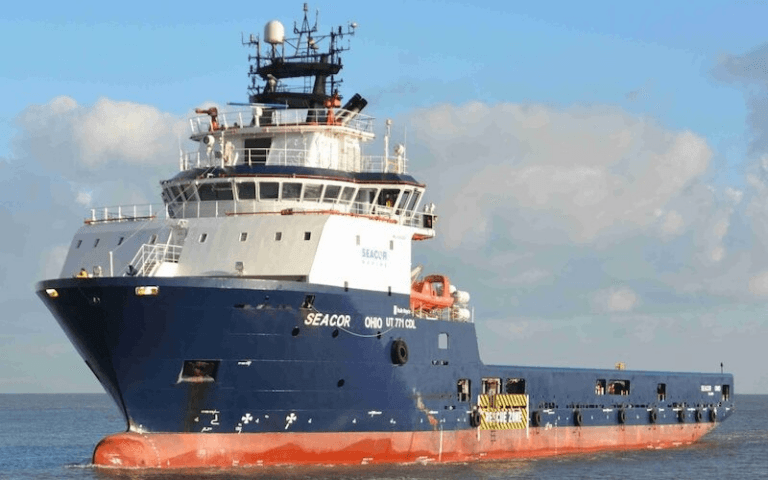
Seacor Marine: when the fleet may be worth more than the company
Shareholder pressure has pushed Seacor Marine into a strategic review. The vessels appear valuable, but the real question is whether the company can produce an adequate return from operating them
Seacor Marine has confirmed that it is evaluating a sale, merger, business combination or further asset disposals following pressure from significant shareholders.
The argument presented to the board is apparently simple: Seacor’s modern offshore fleet is worth considerably more than the company’s market capitalisation. Therefore, selling the company—or its vessels—could unlock value currently denied to shareholders.
But shares do not operate vessels. They do not secure contracts, maintain class, improve uptime or produce cash flow. A shipping company ultimately derives its value from the quality of its assets, operational reliability, commercial performance and ability to generate returns.
That is precisely where the Seacor discussion becomes more complex.
Valuable steel, disappointing returns
Pointillist Family Office, which holds approximately 7.2% of Seacor, estimates the company’s PSVs at between US$500 million and US$550 million, its fast support vessels at US$240 million to US$280 million and its liftboats at US$110 million to US$150 million.
The component valuations total between US$850 million and US$980 million. Pointillist argues that, together with the company’s other assets, they support an enterprise value exceeding US$1 billion and a net asset value above US$20 per share.
There is evidence that Seacor’s vessels are carried below market value.
During 2025, the company received US$129.2 million from asset sales and recognised gains of US$63.4 million. The assets sold therefore had a combined book value of only around US$65.8 million. Selected vessels were sold for almost twice their carrying value.
The same pattern continued in the second quarter of 2026, when five vessels and other equipment produced US$44.7 million in proceeds and a gain of US$31.3 million.
The hidden asset value is not imaginary. The problem is that an appraisal is not cash, and gross fleet value is not equity value.
Debt must be repaid. Newbuild instalments remain outstanding. Transaction costs, taxes, corporate liabilities and eventual wind-down expenses must also be considered. Moreover, a large fleet sold together will not necessarily achieve the combined value of each vessel sold separately.
Offshore Accounts estimates that whole-fleet transactions can attract a discount of approximately 20%, primarily because the universe of buyers capable of funding a major acquisition is considerably smaller than the universe capable of purchasing one or two vessels.
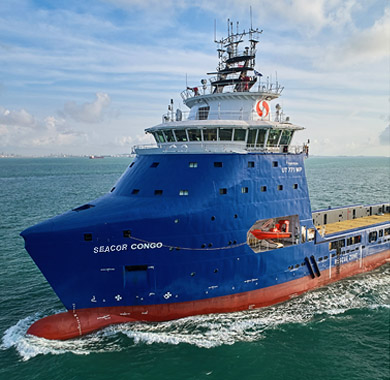
Seacor’s Jones Act exposure further limits the range of potential corporate buyers.
The claimed value is therefore plausible, but far from guaranteed.
The economics explain the pressure
The more significant problem is not Seacor’s share price. It is the performance of the underlying company.
In 2025, Seacor generated US$227.8 million in revenue and US$46.1 million in direct vessel profit. General and administrative expenses—commonly referred to as G&A—reached US$47.5 million.
In other words, the entire direct contribution from the fleet was insufficient to pay for the corporate structure, even before depreciation and US$36.1 million of interest expense.
Seacor ended the year with a net loss of US$27.8 million and negative operating cash flow of US$36.4 million. Once capital expenditure is included, the business consumed approximately US$85 million before receiving proceeds from vessel sales.
The second quarter of 2026 was not fundamentally different.
Seacor reported net income of US$3.3 million, but this included the US$31.3 million gain on asset disposals. Excluding that gain, the underlying operating result was negative by approximately US$15.4 million. Operating cash flow remained negative by US$13.2 million.
The fleet is producing some encouraging results. PSV rates reached US$28,443 per day in the second quarter, with utilisation of 70%, while FSV utilisation reached 74%.
The liftboats, however, recorded utilisation of only 24%. Two premium units in the Middle East remain under maintenance and were not expected to operate during the third quarter.
Selling vessels has helped protect liquidity and demonstrate their market value. But every disposal also removes part of the company’s revenue-producing base.
Unless overhead falls at approximately the same pace, each sale makes the remaining company progressively more expensive to operate.
Seacor and Tidewater in 2025
| Seacor Marine | Tidewater | |
| Revenue | US$227.8M | US$1.35Bn |
| Fleet utilisation | 66.0% | 76.1% |
| Average day rate | US$18,899 | US$22,573 |
| G&A as percentage of revenue | 20.8% | 9.9% |
| Operating cash flow | US$(36.4)M | US$379.1M |
Why Tidewater receives a premium
The comparison with Tidewater is particularly revealing.
Tidewater operated 208 vessels at the end of 2025, generating US$1.35 billion in revenue, US$598.1 million in adjusted EBITDA and US$379.1 million in operating cash flow.
Its G&A was significantly higher in absolute terms, at US$134.5 million, but represented only 9.9% of revenue and approximately US$630,000 per vessel. At Seacor, G&A represented 20.8% of revenue and more than US$1 million per vessel.
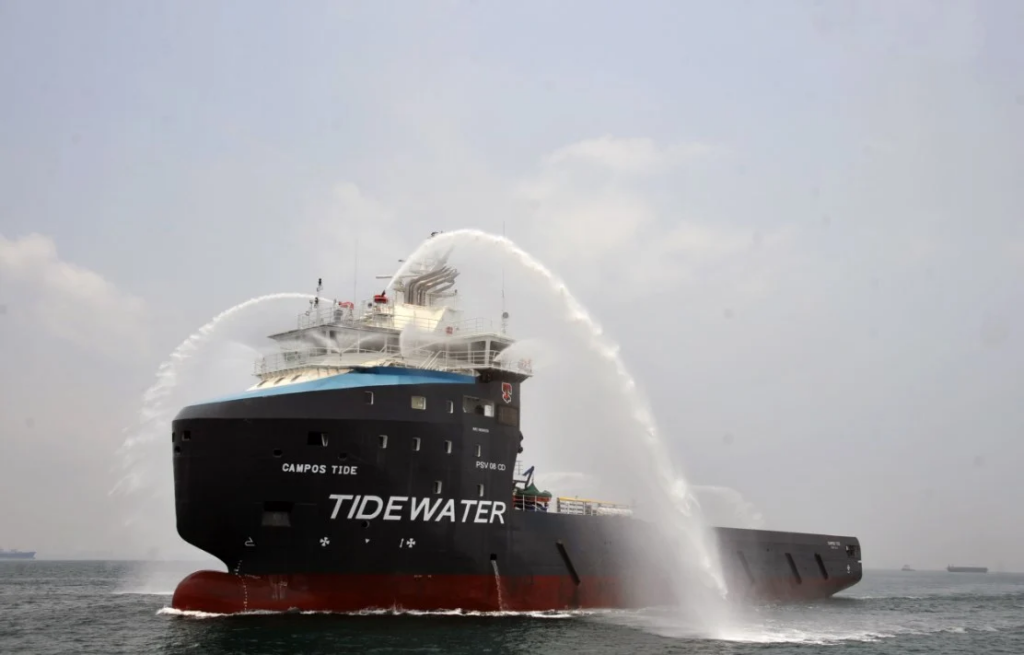
Tidewater’s fleet was also older on average. This did not prevent the company from producing considerably better utilisation, cash flow and returns.
This is the essential point: the market is not valuing Tidewater’s steel alone. It is valuing an operating platform capable of converting vessels into earnings.
Scale allows Tidewater to distribute the cost of management, compliance, crewing, technical support and commercial coverage across a much larger fleet. It also provides greater flexibility to reposition vessels, offer substitute tonnage and manage maintenance without disproportionately damaging the wider business.
Operational reliability matters because it converts nominal asset value into working days. Working days generate revenue. Revenue, when properly managed, produces cash.
Creating value—or merely realising it?
“Maximising shareholder value” can become an empty financial-market expression. In Seacor’s case, however, it describes three materially different possibilities.
Improving utilisation, resolving the liftboats, reducing G&A and lowering debt would genuinely create value through better business performance.
Selling or merging Seacor into a larger operator could also create industrial value if the buyer can employ the vessels more efficiently, remove duplicated overhead and finance the fleet at a lower cost.
Selling vessels individually would be different. It would realise value already contained in the assets, rather than create new value.
The danger lies in continuing to sell ships without resolving the future of the company. Asset gains may temporarily improve reported results, but an increasingly small fleet cannot indefinitely support a corporate structure designed for a much larger operation.
The strategic review is therefore rational. It does not, by itself, create value. It merely tests whether another owner is prepared to pay more for Seacor’s vessels than Seacor can justify through its own operating returns.
The fleet countdown
The development of Seacor’s fleet and G&A provides perhaps the clearest summary of the problem.
| Period | Period-end vessels | Reported G&A | Approximate G&A per vessel |
| 2023 | 58 | US$49.2M | US$0.85M |
| 2024 | 54 | US$44.7M | US$0.83M |
| 2025 | 44 | US$47.5M | US$1.08M |
| June 2026 | 38 | US$22.3M for six months | US$1.17M annualised |
The 2026 indicator simply annualises the first-half G&A of US$22.3 million. It is not company guidance, and period-end vessel counts are an imperfect denominator, but the direction remains significant.
Between the end of 2023 and June 2026, Seacor’s fleet declined from 58 to 38 vessels—a reduction of approximately 35%.
Over the same interval, annualised G&A declined by only about 9%. As a result, the approximate corporate cost allocated to each remaining vessel increased from US$850,000 to almost US$1.2 million.
G&A does not have to move in a perfectly straight line with vessel numbers. A listed company retains audit, legal, compliance and management costs regardless of fleet size. International operations and a diverse fleet also require technical and commercial infrastructure.
But fixed costs are not permanently exempt from economic reality. If a company sells more than one-third of its vessels, the organisation supporting those vessels must eventually be redesigned.
The comparison with Maersk is instructive, although the businesses are not direct peers.
Maersk officially lists “Our employees” as one of its five core values. Nevertheless, when market conditions and its cost base changed, it announced the elimination of approximately 10,000 positions in 2023.
In 2026, it announced another restructuring under which around 1,000 corporate positions—approximately 15% of its corporate workforce—would be closed, targeting an annual reduction of US$180 million in corporate overhead.
That is a severe decision and not, by itself, evidence of good management. But it demonstrates an important principle: placing people at the centre of a company does not exempt management from aligning the organisation with the economics of the business.
In fact, protecting the company and its remaining employment may require management to act before an oversized cost structure consumes cash, increases debt and weakens the operating platform.
Maersk’s decision was specifically directed at corporate overhead. Seacor’s disclosures, by contrast, show a fleet that has already been materially reduced without an equivalent adjustment to G&A.
This is the point Seacor’s strategic review must address. Selling vessels while leaving the corporate structure substantially unchanged is not a sustainable restructuring. It progressively transfers more overhead onto fewer revenue-producing assets.
The emerging conclusion is uncomfortable but increasingly difficult to avoid: Seacor may own a valuable fleet, but the present organisation may no longer be its highest-value owner.
The eventual outcome will depend not on the enthusiasm of the share market, but on something considerably more concrete—the net cash a buyer is prepared to pay after debt, liabilities, remaining commitments and execution risk.
The final numbers summarise the issue:
58 vessels. Then 54. Then 44. Now 38.
The fleet has been resized. G&A has not been resized with it.
Unless the strategic review changes that equation—through operational improvement, corporate restructuring or a new owner—the vessels may be worth more elsewhere precisely because Seacor has not demonstrated that it can earn enough from operating them.
This article was produced by Westhon Media for One Energy News.