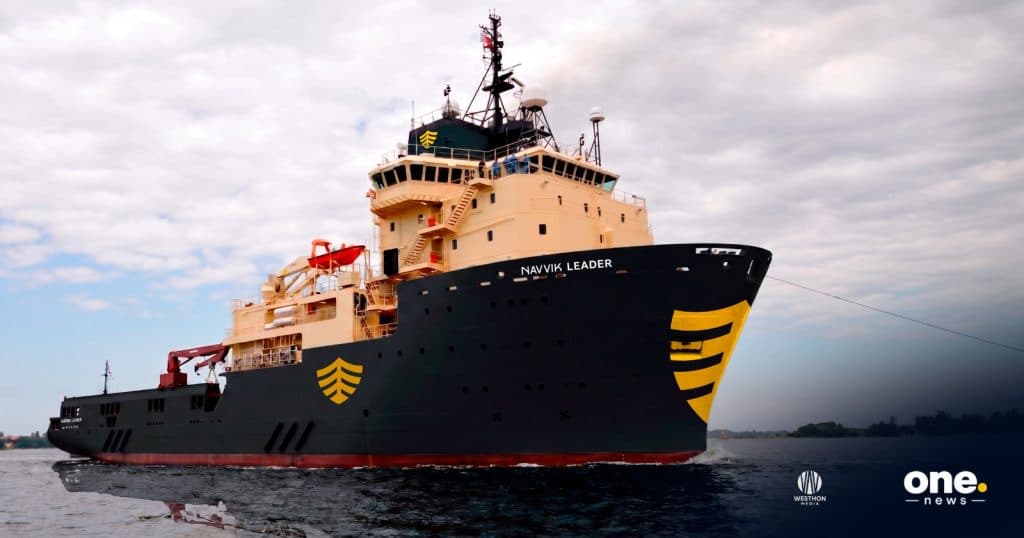
Por Onde Anda? Navvik Leader
Automatically generated translation; may contain errors.
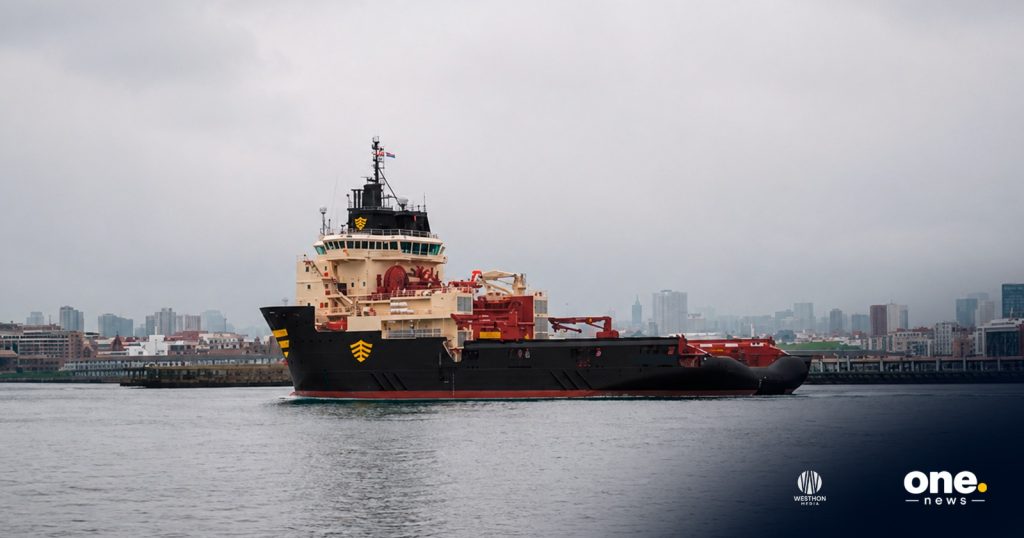
Sitting at anchor in Rio de Janeiro, the former Maersk Leader may look like another AHTS waiting for its next move. But after almost 15 years connected to Brazil’s offshore market, a change of name on its hull now represents something considerably bigger.
Maersk Leader is now Navvik Leader — one of the most visible symbols of a transaction that created a new player in the Brazilian offshore market.
Public AIS data reviewed by One Energy News showed the vessel anchored in Rio on August 30, still carrying the Danish flag, MMSI 220577000 and IMO 9425710. The ship itself has hardly changed. The company behind it certainly has.
The story starts well before Navvik. Delivered in July 2009 by Volkswerft Stralsund in Germany, Maersk Leader was the first of six large AHTSs built in the series for Maersk Supply Service. At 90.3 metres, with 259.3 tonnes of bollard pull, 810 m² of deck and a 500-tonne double-drum anchor handling and towing winch, it belonged to a generation designed for the heavy anchor-handling work associated with deep and ultra-deepwater developments.
Its early career included major North Sea assignments, including the tow of the Gjøa production platform in 2010. Brazil, however, would become a much longer chapter.
WSB-One records the Leader working for Shell from September 2011 at approximately US$49,500 per day. Shortly afterwards came one of the landmark Brazilian AHTS fixtures of that period: Petrobras contracted Maersk Leader, Maersk Lancer and Maersk Launcher for four years of ultra-deepwater anchor handling using conventional and torpedo anchors.
The three-vessel package was worth approximately US$285 million, with WSB-One recording the Leader at US$65,940 per day.
Then the market changed.
Following the offshore downturn, the same vessel returned to term employment in Brazil with Modec in March 2017 at US$25,000 per day — less than half its previous Petrobras rate. Six years later, the cycle was moving again. Petrobras brought the L-class trio back under three-year contracts covering anchor handling and drilling-rig movements, with WSB-One recording the Leader at US$41,000 per day, followed by a short extension into 2026.
US$65,940. Then US$25,000. Then US$41,000.
Few vessels have provided such a clean reading of the Brazilian high-end AHTS cycle.
But while the Leader was going through another Petrobras campaign, an equally important story was unfolding above deck.
A.P. Moller-Maersk had already sold Maersk Supply Service to A.P. Moller Holding in 2023, completing another step in its exit from energy-related businesses. Then, in 2024, DOF announced the acquisition of Maersk Supply Service globally.
There was, however, one important exception: Brazil.
The Brazilian business was carved out of the DOF transaction and continued separately, leaving one of Maersk Supply Service’s most established operating platforms outside the global consolidation of the fleet.
That opened the door to a very different transaction.
In March 2026, a consortium led by ASM Texas Corp. and FV Star One Limited agreed to acquire Maersk Supply Service Brazil. The deal was completed in May and a business that had operated in the country under the Maersk name for decades emerged under a new identity: Navvik.
The vessels followed.
Maersk Leader became Navvik Leader. Maersk Lancer became Navvik Lancer. Maersk Launcher became Navvik Launcher.
It was more than a change of paint and names. With the transaction, Navvik inherited an operating platform, Brazilian market history and a group of vessels that had already spent years performing some of the country’s most demanding offshore assignments.
And the Leader is perhaps the best vessel through which to tell that story.
Seventeen years after leaving the shipyard, it remains a 259-tonne bollard-pull AHTS with capabilities that are becoming increasingly relevant again as Brazil moves through another offshore investment cycle.
Its own employment history tells the story remarkably well: approximately US$49,500 per day with Shell at the beginning of its Brazilian career, US$65,940 with Petrobras during the previous offshore boom, US$25,000 with Modec after the downturn and US$41,000 when Petrobras called the L-class vessels back in 2023.
Same vessel. Different owners. Very different markets.
Now the Petrobras cycle is over and Navvik Leader is anchored in Guanabara Bay under its new name.
From the AIS screen, that could easily look like the end of one contract and the beginning of a period of waiting.
We would not be so quick to reach that conclusion.
There may be more behind the Leader’s quiet presence in Rio than the AIS track currently reveals — and its next chapter may be closer than it appears.
For now, we will leave it there.
Stay tuned.
This article was produced by Westhon Media for One Energy News.