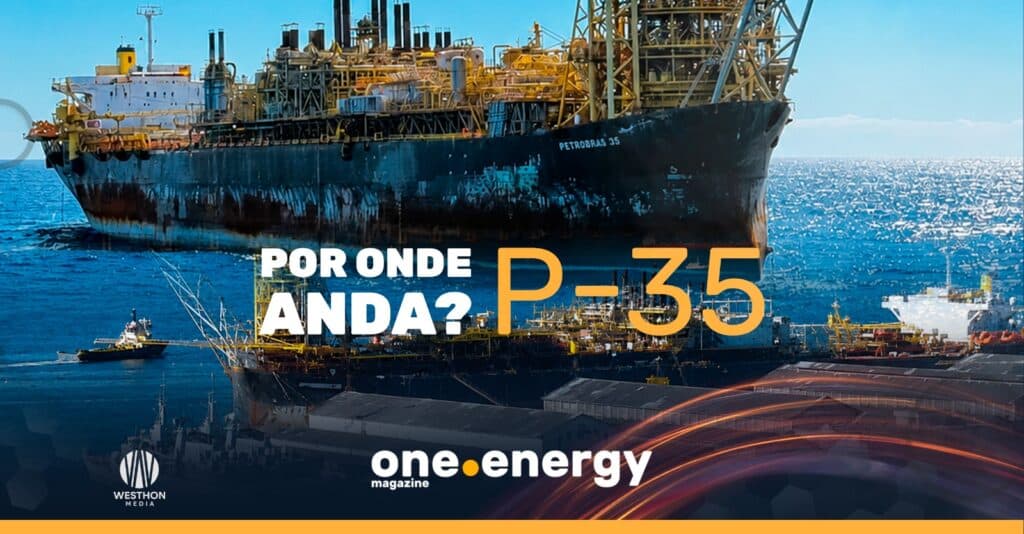
Por onde anda? FPSO P-35
Automatically generated translation; may contain errors.
There are offshore units that operate quietly…
And there are those that, even in silence, define an era.
P-35 was one of them.
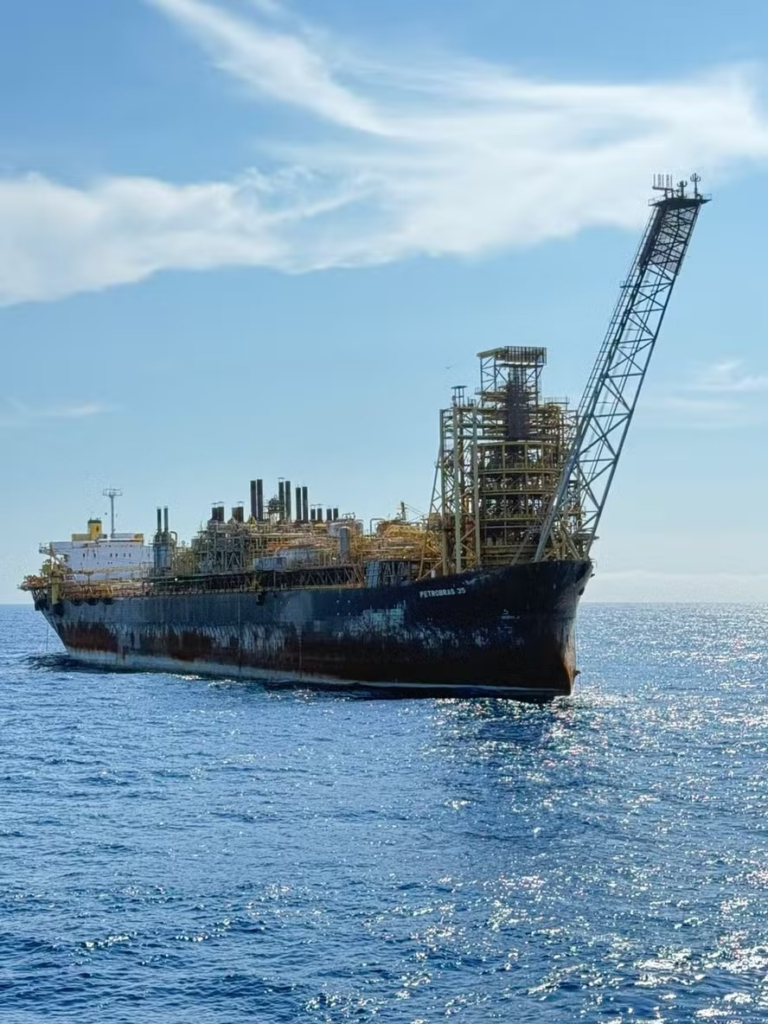
For years, far beyond the horizon, she remained anchored in the Campos Basin, transforming crude from deep waters into one of Brazil’s most strategic assets: energy.
Today, after more than two decades in operation, she no longer produces.
Now deactivated from offshore production by Petrobras, the platform leaves behind more than steel and systems.
It leaves a question.
But also a story still worth revisiting.
From Tanker to Offshore Giant
Before becoming one of Brazil’s early FPSOs, the platform had a different life.
Originally built in Japan in 1974 as the tanker José Bonifácio, the vessel was converted into an FPSO in 1999 as part of Petrobras’ strategy to accelerate deepwater production through adapted floating systems.
At that moment, the conversion of tankers into FPSOs was becoming a strategic solution for rapidly expanding offshore production capacity in Brazil.
It was a pivotal moment — not only for the vessel, but for Brazil’s offshore trajectory.
A Pillar of Marlim
Shortly after conversion, P-35 was installed in Marlim Field in 1999, one of the most important assets in the Campos Basin.
At the time, Marlim was one of the most important offshore developments in the world and a central part of Brazilian offshore production expansion during the late 1990s and early 2000s.
From that point forward, she became exactly what the offshore industry values most:
Reliable.
Consistent.
Essential.
For more than two decades, the platform operated with little visibility outside the industry — but with enormous impact within it.
Its numbers help explain her scale:
Production capacity: approximately 130,000–135,000 barrels of oil per day
Storage capacity: close to 1 million barrels
Operational water depth: approximately 850 meters
Operational life: more than 20 years connected to offshore production
Over time, she processed volumes difficult even to fully comprehend — quietly supporting part of Brazil’s production during critical phases of offshore expansion.
P-35 belonged to the first major generation of Brazilian FPSOs that helped transform offshore production in the Campos Basin and consolidate Brazil as a global reference in deepwater offshore operations — long before pre-salt became dominant.
The Quiet Exit
Her departure, much like her operation, happened without spectacle.
In 2024, Petrobras ended production operations of the platform within the broader Marlim revitalization program, while studies related to possible reuse and redevelopment continue under evaluation.
And even after the end of her operational life, P-35 has not completely disappeared.
Which means she may not yet have reached her final destination.
Where Is She Now?
At WSB Advisors, our connection with the sea is not abstract.
It is daily.
It is visible.
It is intentional.
From our offices, overlooking one of Brazil’s busiest marine corridors, we monitor in real time the movement of vessels that shape the industry we cover.
It is no coincidence.
The choice of where we work reflects what we do.
And sometimes, the offshore world comes closer than expected.
Right in front of us.
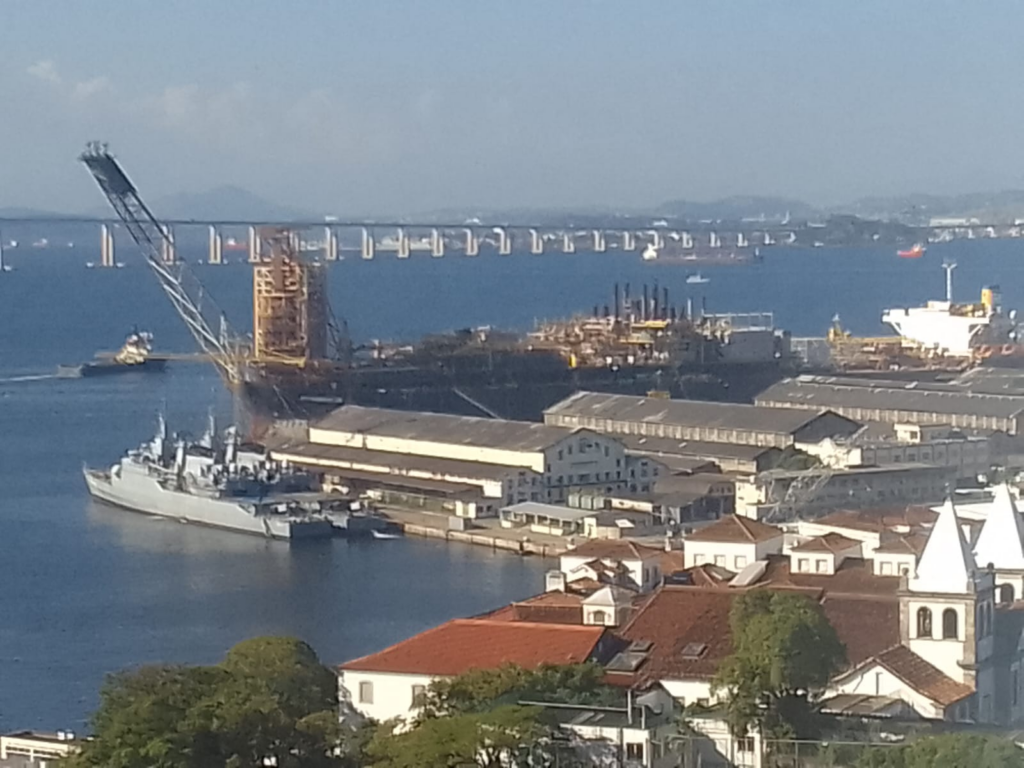
This week, the image above — captured from WSB Advisors’ office on Avenida Rio Branco, downtown Rio de Janeiro — shows her currently positioned alongside the Navy’s berth, a silent giant that no longer operates, but remains very much present.
There is something symbolic about that.
A platform that once operated hundreds of kilometers offshore…
Now resting within sight.
A reminder that, in this industry, even the largest assets eventually return — not to the spotlight, but to observation.
From a distance.
From the shore.
From our windows.
For years, she existed almost exclusively offshore, outside public visibility. Seeing the platform positioned close to the coastline today creates an unusual contrast for those familiar with her operational history.
And perhaps that is exactly what still makes P-35 draw attention even after leaving production.
And perhaps, for the first time, we can answer the question:
Where is P-35 today?
For now — right before our eyes.
For our offshore industry, few images explain the passage of time as clearly as this one.
Every Thursday, a new “Por Onde Anda?”.
This article was produced by Westhon Media for One Energy News.