Editorial: Four Years On, Guanabara Bay’s Ship Graveyard Remains. At WSB Seminar 2026, RINA Will Address the Future of an Aging Fleet.
Also available in Portuguese
Editorial: Quatro anos depois, resta o cemitério da Baía de Guanabara. No Seminário WSB 2026, RINA vai falar sobre o futuro de uma frota de idosos.Read in Portuguese →Automatically generated translation; may contain errors.
A new GloboNews report highlights a longstanding problem in Guanabara Bay. As offshore support vessels approach 25 and 30 years of service, safely extending their operational lives will take center stage in an exclusive interview with RINA, hosted by Alexandre Vilela at WSB Advisors Seminar 2026.
One Energy News | Westhon Media
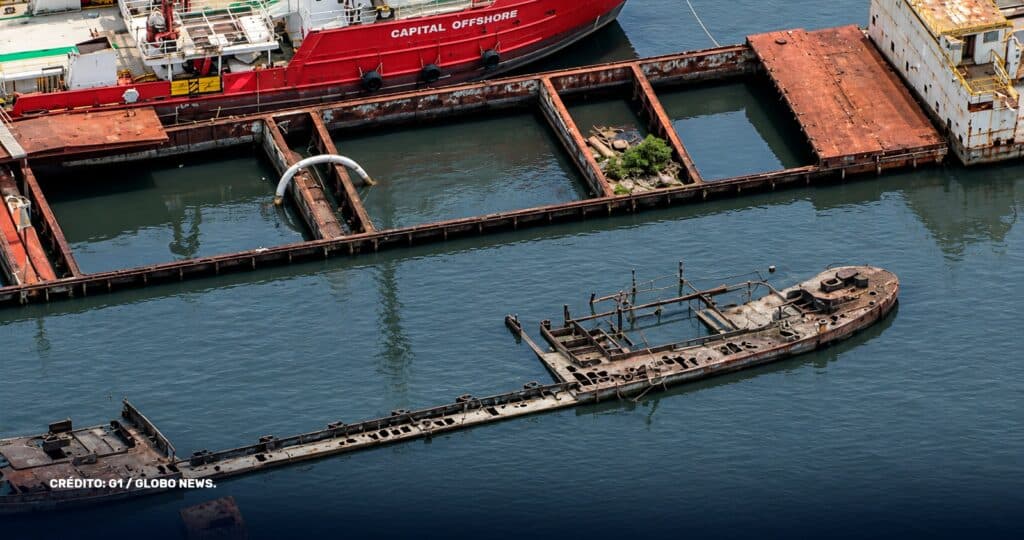
Four years after the cargo ship São Luiz struck the Rio–Niterói Bridge in November 2022, Guanabara Bay remains home to what has become known as a ship graveyard.
A new GloboNews investigation, published by g1 on November 14, 2026, shows that the problem remains unresolved.Dozens of abandoned hulls, partially submerged vessels and deteriorating structures continue to occupy the bay.
The footage also reveals something particularly troubling: alongside severely corroded and damaged vessels are others that still appear to be in reasonably good condition, yet remain laid up in an environment increasingly associated with abandonment.
The warning goes well beyond environmental concerns. As Brazil’s offshore support fleet continues to age, situations like these could become an increasingly common challenge.
This is precisely the issue that will take center stage at WSB Advisors Seminar 2026, during an exclusive interview with RINA, conducted by Alexandre Vilela, CEO of WSB Advisors, on extending the service life of offshore support vessels and exploring solutions for other segments of the maritime industry.
A Longstanding Problem — Closely Followed by WSB
WSB Advisors has monitored the issue of abandoned vessels in Guanabara Bay for years, including providing technical support to the Rio de Janeiro State Legislative Assembly (ALERJ) during the work of its Parliamentary Commission of Inquiry into abandoned and inactive vessels, established in 2023.
Investigations and reporting over the years have revealed the different paths that can lead a vessel into prolonged inactivity, deterioration or improper dismantling.
Among the cases followed by WSB are the Saveiros Albatroz and three India-linked offshore support vessels — Suvarna, Sudaksha and Subhiksha — originally owned by Varun Shipping and historically associated with Wilson Sons Offshore’s Brazilian operations.
In previous coverage, WSB reported that two of these vessels had been dismantled, while Suvarna remained in Guanabara Bay amid serious environmental concerns.
Wilson Sons Ultratug’s offshore operations were subsequently acquired by Tidewater in August 2026, a transaction that does not, in itself, establish responsibility for events predating the acquisition.
The industry has also witnessed the closure of Superpesa facilities by environmental enforcement authorities in February 2025, following findings of shipbreaking activities without the required environmental permits and indications of pollution affecting Guanabara Bay.
Further concerns have emerged from operational safety incidents involving vessels associated with Astromarítima.
While each case has its own circumstances and responsibilities, all point to a fundamental issue:
The end of a contract — or even the end of a vessel’s commercial operations — does not bring an owner’s, manager’s or operator’s responsibilities to an end.
An Aging Fleet That Still Needs to Work
The issue becomes even more significant when viewed against the broader offshore market.
According to Westwood market data published in September 2026, the average age of the global offshore support vessel fleet has reached approximately 16 years, with more than half of operational vessels having exceeded 15 years of service.
In certain segments, vessels approaching 25 or 30 years of age remain part of the available offshore fleet.
Fleet renewal faces substantial obstacles: high capital requirements, limited access to financing and guarantees, uncertainty over contract duration, and constraints on shipbuilding capacity.
Demand for vessels remains strong, but newbuilding activity does not necessarily keep pace with the market’s operational needs.
The world — and Brazil in particular — faces a growing challenge: how can an increasingly aging fleet remain operational without compromising safety standards?
Age alone does not determine a vessel’s condition. A 30-year-old ship can remain safe and commercially efficient when supported by proper maintenance, rigorous inspections and technically justified upgrades.
The real concern arises when commercial pressure to extend a vessel’s working life is not matched by the investment required to maintain its structural integrity and operational reliability.
RINA: Vessel Life Extension Takes Center Stage at WSB Seminar 2026
This will be the central theme of the exclusive interview with RINA, hosted by Alexandre Vilela, at WSB Advisors Seminar 2026.
The discussion will explore how to assess a vessel’s remaining service life, identify the investments required to keep it operational and establish the point beyond which further life extension can no longer be justified on safety or economic grounds.
RINA already offers a ship life-extension program that draws on structural fatigue assessments, vessel operating histories, metocean conditions and digital modeling.
In Brazil, the organization has also published details of life-extension engineering work for Brazilian Navy vessels, including structural assessments, corrosion analysis, inspections and maintenance planning.
The interview will provide an opportunity to discuss how such approaches can be applied to the realities facing Brazilian shipowners and other segments of the maritime industry.
The objective is not to keep aging vessels operating at any cost. It is to establish, through sound and independent technical assessments, which ships can safely remain in service, under what conditions and for how long.
WSB Advisors Seminar 2026 is presented by RINA, with the participation of WSB-One and Intcom Solutions, and exclusive media coverage by One Energy News.
Guanabara Bay: A Warning the Industry Cannot Ignore
The GloboNews report exposes the consequences of a problem Brazil’s maritime industry has yet to address adequately: what happens to vessels when they are no longer commercially viable.
An aging fleet calls for two complementary responses: technically sound life-extension programs for vessels that can safely remain in service, and environmentally responsible decommissioning for those that have reached the end of their economic lives.
Without both, the country risks turning assets that once represented investment, employment and operational capacity into environmental liabilities and navigational hazards.
Guanabara Bay has become the most visible symbol of that failure.
Four years after the São Luiz accident, its abandoned hulls remain a stark warning.
At WSB Seminar 2026, RINA will address one of the offshore industry’s most pressing questions: how to safely extend the working lives of vessels that the market still needs.
Because the challenge is not simply to build the ships of tomorrow. It is also to maintain, operate and, when the time comes, responsibly retire the ships we already have.
One Energy News — Westhon Media
Original report: g1 / GloboNews — November 14, 2026
This article was produced by Westhon Media for One Energy News.