Tech Compass · From the magazine
Tech Compass #3
Automatically generated translation; may contain errors.
The Future of Data Has Everything to Do with CDs and DVDs — Just Not the Way You Think
Project Silica and the Future of Cold Data Storage
By Romulo Bacchiega

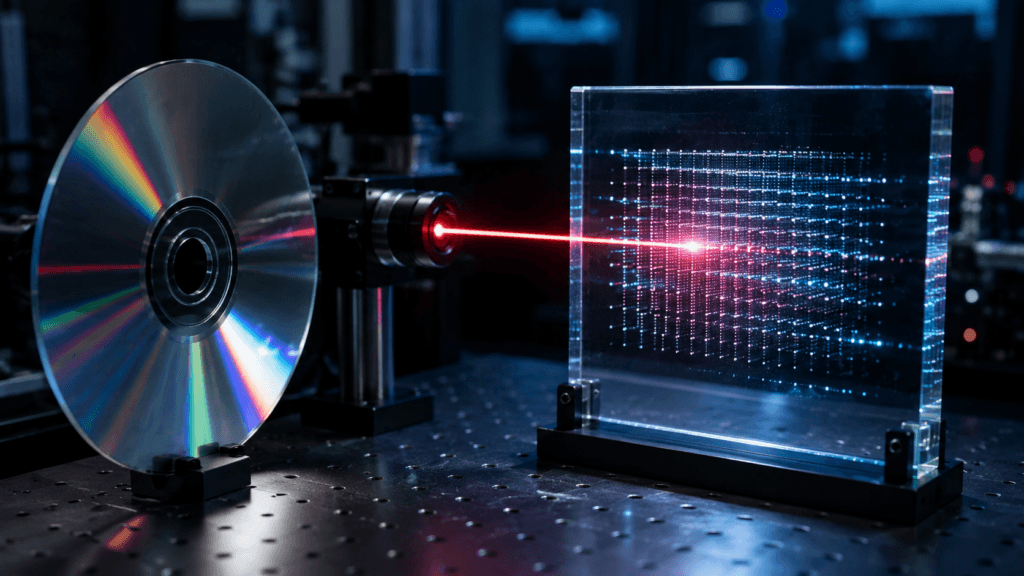
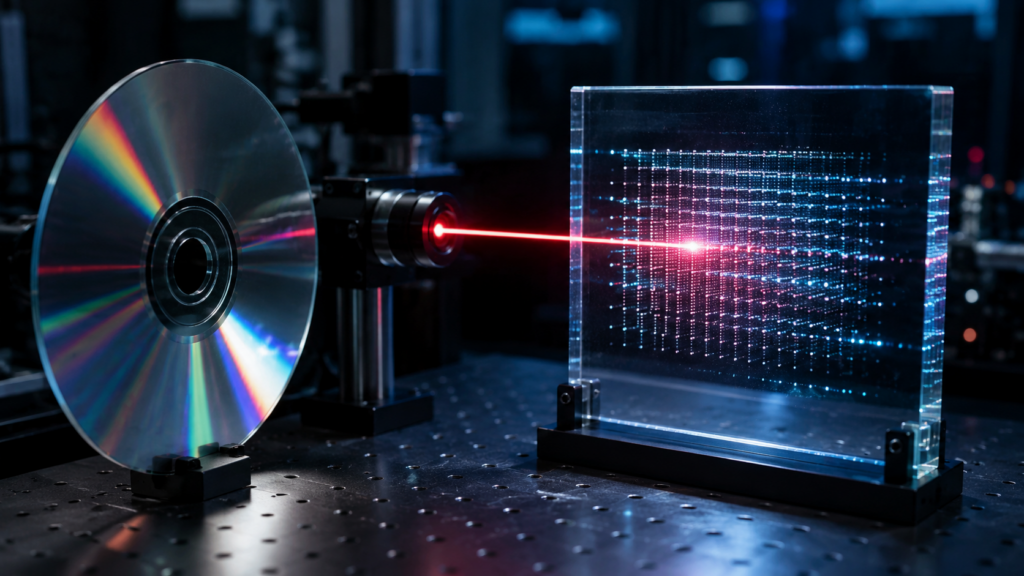
CDs and DVDs use lasers to write and read information on a physical medium. Project Silica, Microsoft’s long-term storage initiative, does something conceptually similar: it uses laser pulses to encode data inside glass plates. The technology is entirely different, the scale is vastly greater, and the durability is in another league altogether, but the underlying principle remains the same: storing information in physical matter.
There is an interesting irony in the digital age. The more advanced our technology becomes, the more dependent we are on storage systems that require continuous maintenance. Hard drives fail, magnetic tapes degrade, and the cloud—while highly effective—still relies on vast physical infrastructure consuming significant amounts of energy and resources to keep data available.
The question remains remarkably simple: where do we store, safely and for the long term, the information that simply cannot be lost?
A Principle That Hasn’t Changed
For thousands of years, humanity has preserved knowledge by recording it on durable physical media. In the maritime industry, there is a fitting parallel. Archimedes’ principle, discovered more than two millennia ago, remains the fundamental law that keeps every vessel afloat, from ancient ships to modern FPSOs. Technology evolves, but certain physical principles remain timeless.
Project Silica follows the same logic: using the unique properties of glass to address a distinctly modern challenge—long-term digital preservation.
How It Works
Developed by Microsoft’s research team in Cambridge and detailed in Nature in February 2026, the technology uses femtosecond laser pulses to write data directly inside glass plates. These pulses create microscopic structures known as voxels, distributed across multiple layers within the material.
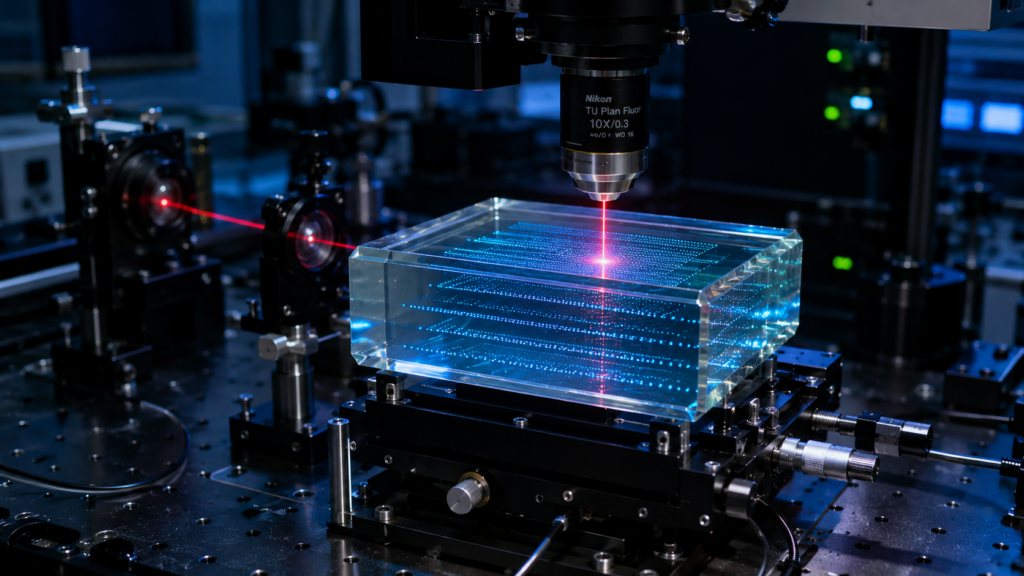
One of the project’s most significant breakthroughs was extending the technology from expensive fused silica to borosilicate glass—the same material commonly used in laboratory equipment and household cookware. Beyond the scientific achievement, this represents an important step toward commercial viability.
The numbers are impressive. A single glass plate just two millimeters thick can store up to 7 terabytes of data. Once written, the information requires no cooling, humidity control, or periodic migration, and the projected lifespan exceeds 10,000 years.
Cold Data: An Overlooked Challenge
Not every piece of information needs to be instantly available. In IT terminology, so-called cold data refers to information that is rarely accessed but must remain preserved and retrievable for decades.
For the energy, oil and gas, and marine sectors, this includes historical contracts, well records, seismic surveys, inspection reports, regulatory documentation, patents, and strategic intelligence. The volume of this information continues to grow, and so do the challenges associated with preserving it.
The issue is not simply storage cost. It is long-term reliability. Tapes deteriorate, disks fail, and cloud providers change policies, architectures, or business models. Ensuring data integrity over multiple decades remains one of the industry’s most persistent challenges.
There is also a growing factor that cannot be ignored: artificial intelligence. The rapid expansion of AI workloads is driving demand for larger data centers, greater computing capacity, and significantly higher energy consumption across the digital infrastructure ecosystem. As a result, technologies designed specifically for long-term archival storage are becoming increasingly relevant.
Project Silica was created precisely for this purpose. It is not intended to compete with high-performance storage systems. Instead, it aims to provide a reliable, ultra-long-term preservation layer with virtually no ongoing energy consumption.
Warner Bros. was among the first organizations to test the concept, storing the film Superman on a glass plate as part of a pilot project with Microsoft. The objective was straightforward: evaluate a storage medium capable of preserving large digital archives for extremely long periods without the operational burden of traditional infrastructure.
The Challenges Ahead
Despite its promise, Project Silica remains far from becoming a mainstream storage solution.
Writing costs remain high, data retrieval requires specialized equipment, and read/write speeds are nowhere near those of conventional storage technologies. In its current form, the platform is unsuitable for applications requiring frequent or real-time access.
However, technology history offers plenty of examples of innovations that began as expensive and impractical before becoming widely accessible through scale and maturation.
In February 2026, Microsoft officially concluded Project Silica’s research phase and indicated that the findings will contribute to future storage solutions within the Azure ecosystem.
Looking Forward
It would be premature to suggest that glass-based storage will become the dominant industry standard anytime soon. Significant economic and operational hurdles still need to be overcome.
But perhaps that misses the larger point.
The true significance of Project Silica lies in demonstrating that digital information can be preserved for millennia without continuous power consumption or recurring maintenance cycles. More than a product, it represents a new technological foundation for long-term data preservation.

Perhaps one day energy companies will be able to purchase archival storage services with century-scale preservation guarantees. Perhaps an organization’s most valuable information will no longer depend exclusively on active servers housed in climate-controlled facilities, but instead reside on silent glass plates designed to outlast generations.
Whether or not that future arrives exactly as envisioned remains to be seen. What science has already proven, however, is that such a future is possible—and that alone makes Project Silica worth watching.
This article was produced by Westhon Media for One Energy News.