Digital Minds · From the magazine
Digital minds #1
Automatically generated translation; may contain errors.
Brain Rot”: when the brain starts melting — and no one notices

There’s a scene that’s becoming increasingly common.
Maybe you’ve seen it.
Maybe you’re part of it.
Someone sitting in a public place — airport, waiting room, restaurant, even at home — phone glued to their face, volume all the way up, random videos colliding nonstop. The world around them simply disappears. Someone calls out, something happens, the environment changes — nothing gets through. Reality turns into background noise.
This isn’t just poor digital manners.
It’s a symptom.
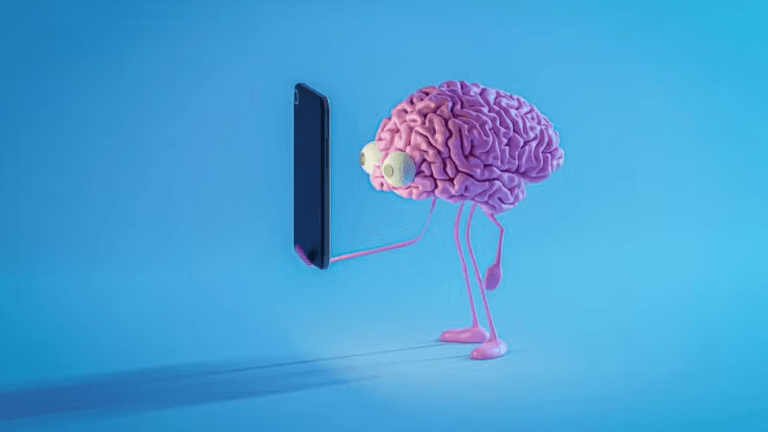
In recent years, a term started circulating — a bit clumsy, almost funny, but dangerously accurate: brain rot. Something like “cerebral decay.” The Oxford Dictionary decided to formalize the expression in 2024. Not because it became trendy, but because pretending it isn’t happening became impossible.
Brain rot is not a clinical disease. It’s not clinical ADHD either — despite how many people now walk out of doctors’ offices with that label, as if it were something you “catch” after 30 from too many notifications. But the practical effect looks very similar: a brain that is permanently distracted, restless, and dependent on stimulation. A brain trained to jump, not to go deep.
And before anyone says, “this is a younger generation problem,” just look around. The phenomenon is democratic. Teenagers hypnotized by 15-second videos. Adults who can’t read a report without checking their phone five times. Elderly people watching reels at concert-level volume, completely detached from the world around them. Brain rot doesn’t choose age. It chooses habit.
The problem isn’t technology. It never was.
The problem is the model of constant stimulation.
Platforms don’t want ten minutes of your deep attention. They want hours of your fragmented attention. Every notification, every like, every “just one more” video activates the same basic circuit: fast, cheap, repeatable dopamine. Instant pleasure, zero effort — and the brain loves that.
Here’s the uncomfortable part: this mechanism is the same one exploited by drugs and gambling. Not in form, but in logic. Unpredictable reward, frequent stimulus, a brief hit of pleasure followed by emptiness. Dopamine doesn’t make moral judgments. It doesn’t care whether it came from alcohol, cocaine, betting, or a video that “nailed” the algorithm. It learns only one thing: it wants more.
The difference is that this dealer lives in your pocket — and you still call it entertainment.
The side effects show up later. Focus becomes effort. Long reading feels exhausting. Complex decisions irritate. Deep thinking starts to feel heavy. Not because people became less intelligent, but because they became poorly trained. A brain conditioned to easy stimulation begins to reject anything that demands patience.
Now bring this into the offshore world.
Offshore environments do not forgive distraction. There is no “airplane mode” for wrong decisions, poorly executed checklists, or rushed interpretations of technical data. Concentration isn’t an abstract virtue; it’s a safety requirement. Mental clarity isn’t a luxury; it’s an operational prerequisite.
When professionals spend most of their off-duty time consuming shallow, hyper-fragmented, nonstop content, that doesn’t stay outside the platform or the office. The brain doesn’t separate “free time” from “critical time.” It operates the way it was trained.
The result is silent — and dangerous: less tolerance for long processes, more anxiety for immediate answers, more errors driven by impatience. In a sector where wrong decisions are expensive — in money, assets, and sometimes lives — this isn’t a behavioral detail. It’s risk.
Now think about children.
An adult brain can still, with effort, be retrained. A developing brain has no defense at all. Children and teenagers are being trained from an early age to avoid boredom, frustration, and silence. They grow up without learning how to sustain attention, without developing emotional depth, without building mental resilience. We are raising a hyper-stimulated, cognitively exhausted generation before adulthood even begins.
A curious movement is emerging: people abandoning social media. Deleting accounts. Disappearing. For some, it’s just fatigue. For others, it’s withdrawal — in the literal sense of the word. Is that the solution? For those already deeply addicted, maybe. As with any addiction, restricting access can be the first step. For most people, the challenge is different: relearning how to use technology without being used by it.
The most ironic part is that almost no one notices when this starts. Brain rot doesn’t arrive with sirens. It installs itself slowly, disguised as entertainment, apparent productivity, and “staying informed.” You probably think you’re being productive. Until the day deep thinking becomes rare — and exhausting.
Maybe the real challenge isn’t reducing technology, but relearning how to use it with criteria. Less automatic stimulation. More silence. Less infinite scrolling. More time holding a single idea until the end — even when it takes effort.
Because, in the end, the brain works like any critical offshore system: if you operate only in superficial mode, failure eventually shows up.
And it almost never gives advance warning.
The question isn’t whether we’re too connected.
That part is already settled.
The question is: what is this connection doing to our ability to think when it actually matters?
This article was produced by Westhon Media for One Energy News.